

Your mission statement tells visitors what you do. Testimonials show them it actually works. The role of testimonials on nonprofit websites goes far beyond decoration. Real voices from real people reduce the skepticism that even well-intentioned donors carry when they land on your site for the first time. This guide covers how to collect testimonials ethically, where to place them for maximum effect, and how to align them with the transparency standards donors increasingly expect. If you manage or oversee a nonprofit website, this is the practical framework you need.
Table of Contents
- Key takeaways
- The role of testimonials on nonprofit websites explained
- How to collect testimonials ethically and effectively
- Strategic placement across your website
- Aligning testimonials with transparency standards
- Using testimonials to drive fundraising results
- My perspective on what most nonprofits get wrong
- Ready to make your testimonials work harder?
- FAQ
Key takeaways
| Point | Details |
|---|---|
| Testimonials build social proof | They show specific, human examples of impact that mission statements alone cannot communicate. |
| Ethical collection requires consent | Use release forms and multiple touchpoints to gather authentic, permissioned stories responsibly. |
| Placement determines effectiveness | Position testimonials near calls-to-action, on donation pages, and on program pages to influence decisions. |
| Combine with transparency signals | Aligning testimonials with verified outcomes and transparency seals deepens donor trust significantly. |
| Treat it as an ongoing process | Refresh testimonials regularly so your site reflects current impact and keeps content sincere. |
The role of testimonials on nonprofit websites explained
A mission statement tells visitors you care. A testimonial from a single mother who kept her family housed because of your emergency fund tells them you delivered. That distinction is the core of social proof, and it is why testimonials carry weight that polished organizational copy simply cannot replicate.
Social proof is a well-documented psychological principle. People look to the experiences of others when evaluating an unfamiliar organization. For nonprofits, this matters especially at the moment a visitor is deciding whether to donate, volunteer, or refer a friend. Testimonials showing peer experiences with names, photos, and detailed accounts increase visitor trust and engagement in ways that organizational messaging cannot.
The difference between a testimonial and an online review is worth noting. Reviews appear on third-party platforms outside your control. Testimonials are curated, permissioned statements gathered directly from participants or donors. That distinction matters because context shapes meaning. A five-star rating says little about which program changed someone’s life. A curated testimonial can say exactly that.
Here is what strong testimonials do for your site:
- Reduce visitor uncertainty about whether your programs actually work
- Give potential donors a relatable entry point into your mission
- Increase the time visitors spend on your website by adding human stories
- Provide evidence that complements your reported outcomes and statistics
- Support social proof on nonprofit websites to convert skeptical visitors into supporters
“Testimonials don’t just build trust. They transfer it. When a program graduate speaks directly to your visitor, they carry credibility you as an organization can never fully supply yourself.”
How to collect testimonials ethically and effectively
Collecting testimonials is not a one-time task you check off a list. Collecting testimonials works best as a continuous process with multiple requests, follow-ups, and explicit consent workflows. Here is how to build that process.
- Identify your collection touchpoints. End-of-program surveys, comment boxes on your website, and newsletters are all productive channels. NCOA recommends multiple touchpoints including surveys, comment boxes, and direct follow-ups with satisfied participants as the most reliable approach.
- Ask at the right moment. Timing matters. GoFundMe Pro advises that donor feedback surveys achieve response rates between 15% and 50% when timed near key moments like the end of a program or the anniversary of a gift. Emotional impact is freshest then.
- Use a consent and release form. Consent is not just a signature. SwitchboardTA emphasizes that meaningful informed consent protects the dignity and autonomy of participants, especially vulnerable individuals. Explain clearly how their words and image will be used, where they will appear, and how long they will remain published.
- Curate with intention. Aim for three to five strong testimonials per key page. A dedicated testimonials hub on your site gives visitors a single place to explore deeper stories while keeping individual pages clean and focused.
- Separate testimonials from review culture. Uncontrolled reviews on third-party platforms can surface out of context. Carefully curated testimonials with proper attribution outperform anonymous reviews in building credibility because they carry a name, a story, and your organization’s context.
Pro Tip: Ask a specific question rather than a general one. “What changed for your family after completing the program?” produces a far more useful testimonial than “Would you recommend us?” Specificity generates stories. Generality generates ratings.
Strategic placement across your website
Knowing you need testimonials is one thing. Knowing exactly where to place them on your site is where nonprofits often fall short. Placing short quotes near calls-to-action and featuring deeper success stories on dedicated pages serves different visitor intentions effectively.
| Placement location | Best testimonial format | Primary goal |
|---|---|---|
| Homepage | Short pull quote with photo | Build immediate credibility |
| Program pages | Two to three sentences with name and outcome | Confirm program value |
| Donation page | Brief donor story or beneficiary quote | Motivate giving at decision point |
| Thank-you page | Peer testimonial from other donors | Reinforce the giving decision |
| Dedicated impact page | Full success story with video | Deepen engagement and sharing |
Video testimonials deserve special attention. Video stories increase message retention and emotional connection more than written stories. Nonprofits with limited budgets can record effective video testimonials using a smartphone, natural light, and a quiet room. The production does not need to be polished. Authenticity carries more weight than production value every time.
Consider a layered approach to your site’s architecture:
- Short quotes (one to two sentences) placed directly beside donation buttons or sign-up forms
- Medium-length testimonials (three to five sentences) embedded within program description pages
- Full stories (video or 300-plus words) featured on a dedicated impact or stories page
- Rotating testimonials on your homepage to keep content fresh for returning visitors
Testimonials increase time on site, visitor engagement, and motivation to donate or volunteer by adding human content that resonates emotionally. When you match the right testimonial format to the right page, you are meeting your visitor at their current level of interest rather than overwhelming them or underserving them.
Pro Tip: Place your strongest testimonial directly above your primary donation button. Visitors read down the page and make a decision at the call-to-action. A compelling human story at that precise moment converts hesitation into action.
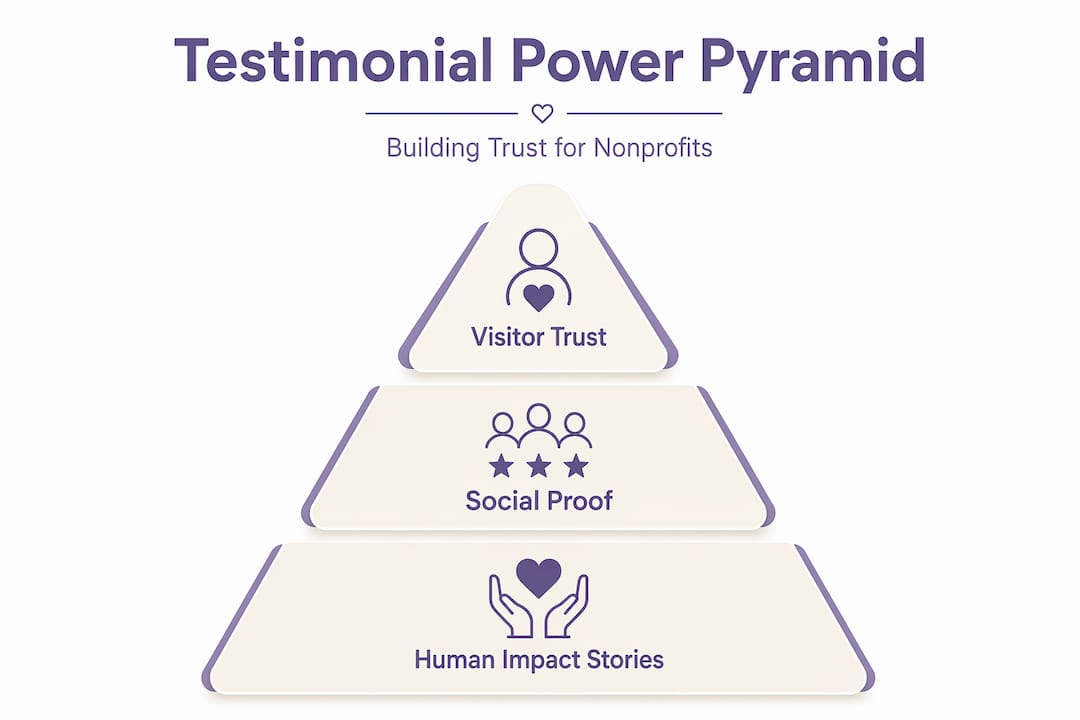
Aligning testimonials with transparency standards
A testimonial without verifiable context is just a nice quote. When it aligns with your documented outcomes and recognized transparency standards, it becomes evidence. That combination is what serious donors increasingly look for.

Candid’s Platinum Seal of Transparency requires data-rich reporting with annual re-verification and measurable program outcomes. Less than 1% of US nonprofits hold this highest transparency tier. Nonprofits at this level benefit from aligning their testimonial stories directly with the outcomes they publicly report. A testimonial describing a 40% improvement in health outcomes carries far more weight when your annual report verifies that same figure.
Here is what a well-aligned transparency and testimonial strategy looks like:
- Testimonials reference specific programs or outcomes that appear in your public reporting
- Your website displays recognized seals such as Candid’s Platinum or Gold alongside testimonial content
- You avoid testimonials that overstate results your data does not support
- You update testimonials when program outcomes change to maintain consistency
“Donors are not naive. They cross-reference what they read on your site with what they see on Candid, GuideStar, and elsewhere. When your testimonials and your data tell the same story, trust compounds.”
Aligning testimonial stories with transparency seals and measurable outcomes increases donor trust and nonprofit credibility in ways that no single piece of content can accomplish alone. Think of it as layered trust: each element reinforces the others.
Using testimonials to drive fundraising results
Testimonials are not passive decorations. Used correctly, they function as active drivers of donor engagement and campaign performance. The following steps apply directly to your fundraising workflows.
- Tie testimonial requests to donor journey milestones. Reach out to donors after their first gift, at the one-year anniversary, or immediately after a campaign closes. These are moments when your organization is top of mind and gratitude is genuine.
- Feature donor-specific feedback in campaigns. A quote from a donor explaining why they give lands differently than organizational copy. It speaks peer-to-peer and addresses the unspoken question every prospective donor has: “Is this worth my money?”
- Amplify testimonials through social media. Pull a powerful sentence from a longer testimonial, pair it with a photo, and share it across your channels with the participant’s permission. This extends your reach beyond your website and builds recognition in your community.
- Encourage visitors to share stories. Add simple share buttons near testimonial content. When a visitor shares a story from your site, they are effectively endorsing your organization to their own network.
- Refresh your testimonials on a schedule. Set a calendar reminder to review your testimonial content every six months. Outdated stories undercut credibility. New stories signal that your organization is actively serving people right now.
You can also incorporate testimonials into your donation funnel at each stage, from awareness through conversion, to reduce drop-off and reinforce the case for giving at every step.
My perspective on what most nonprofits get wrong
I’ve reviewed hundreds of nonprofit websites over the years, and the same pattern shows up repeatedly. Organizations spend weeks crafting their mission statement and forget to ask a single program participant for their story. When they do collect testimonials, they often treat them as a formality: one generic paragraph buried at the bottom of the About page.
What I’ve found is that the most effective testimonials are specific to the point of being uncomfortable. Not “this program changed my life” but “before I found this program, I was about to lose my apartment. Three months later, I had stable housing and a job interview lined up.” That level of detail is what converts a curious visitor into a committed donor.
I’ve also noticed that nonprofits consistently underestimate the connection between their website’s design and how testimonials land. A powerful quote presented in a cluttered layout with a low-resolution photo loses most of its impact. Well-designed nonprofit websites give testimonial content the visual space it needs to breathe and resonate.
The other mistake I see often is treating consent as a checkbox. Consent is a conversation, especially when you are working with vulnerable populations. When participants understand how their story will be used, they often provide more detail and more honest feedback because they feel respected, not extracted.
Testimonials influence donor psychology at a level beyond surface trust. They activate something closer to identification. A potential donor reads a story and thinks, “I know someone like that” or “That could have been me.” That is the moment the decision to give shifts from obligation to genuine connection.
— Matt
Ready to make your testimonials work harder?
Your testimonials are only as effective as the website presenting them. If your current site buries impact stories in a wall of text or lacks the structure to guide donors toward giving, the content is not reaching its potential.
At Nonprofit-webdesign, we have spent nearly two decades helping organizations build websites that present testimonials where they belong: at the center of the donor’s decision-making experience. Our website redesign services are built around accessibility, SEO readiness, and the kind of purposeful design that makes authentic stories land with full impact. We also offer support and care plans to keep your testimonial content current, consent-compliant, and properly integrated as your organization grows. If you have questions about structuring your site’s content, our nonprofit website FAQ is a practical starting point.
FAQ
What is the role of testimonials on nonprofit websites?
Testimonials provide social proof that a nonprofit’s programs deliver real results, reducing donor uncertainty and increasing engagement beyond what mission statements alone can achieve.
How many testimonials should a nonprofit display per page?
Three to five curated testimonials per key page is the recommended practice, with short quotes near calls-to-action and longer success stories on dedicated impact pages.
Why is consent so important when collecting testimonials?
Consent protects participant dignity and autonomy, particularly for vulnerable individuals, and ensures that testimonial use complies with ethical governance standards and organizational policies.
How do testimonials support nonprofit fundraising campaigns?
Testimonials placed at key points in the donor journey, such as donation pages and thank-you pages, provide peer-level validation that motivates giving and reduces hesitation at the point of conversion.
How often should nonprofits update their testimonials?
Reviewing and refreshing testimonial content every six months keeps stories current, accurate, and consistent with your reported program outcomes and transparency documentation.