

Your program services page is one of the most visited pages on your nonprofit’s website, yet it’s often the most neglected. Many organizations treat it like a marketing brochure, full of inspiring language but short on substance. The result? Donors lose confidence, auditors find gaps, and funders move on. When you create a nonprofit program services page that works, it does double duty: it builds trust with the people who fund your work and gives you a governance document that holds up under scrutiny. This guide walks you through exactly how to do that.
Table of Contents
- Key takeaways
- How to create a nonprofit program services page that works
- Writing program descriptions that inform and engage
- Common mistakes that undermine program pages
- Applying human-centered design to your program page
- Verifying and optimizing your program page
- My perspective on program pages that actually hold up
- Ready to build a program page that earns trust
- FAQ
Key takeaways
| Point | Details |
|---|---|
| Preparation comes first | Clarify your mission alignment and analyze local services before writing a single word. |
| Use a program logic model | Map inputs, activities, outputs, and outcomes to give funders and auditors the clarity they expect. |
| Avoid the brochure trap | Program pages that read like fundraising copy often fail compliance reviews and lose funder confidence. |
| Human-centered design matters | Clear language, real stories, and accessible layout increase donor empathy and engagement. |
| Treat it as a living document | Regular updates to financial and operational data protect donor trust and tax-exempt status. |
How to create a nonprofit program services page that works
Before you write a single sentence, you need the right foundation. Skipping this step is the single biggest reason program pages underperform, both with donors and during compliance reviews.
Start by getting clear on how each program directly supports your stated mission. If you cannot draw a straight line from a program’s activities to your mission statement, the program description will feel vague, because it is. Funders notice this immediately.
Next, conduct an honest environmental analysis. Ask yourself whether similar services already exist in your community. A Go/No-Go assessment before launching or documenting a program protects against duplicating existing local services and helps you identify where partnerships make more sense than competition. This kind of ecosystem awareness is the difference between a program page that reads as credible and one that raises red flags.
You also need to define your target population with precision. “Low-income families” is not enough. Specify geography, age range, income threshold, and the specific problem you are addressing. This specificity feeds directly into your program descriptions and sets the tone for everything else on the page.
Finally, gather the operational details you will need:
- Staffing requirements and qualifications for each program
- Cost structure per participant or service unit
- Service delivery model (in-person, virtual, hybrid)
- Program hours, location, and enrollment or intake process
- Safety standards and service protocols, especially for direct-service programs
Pro Tip: For programs that serve vulnerable populations, documented service protocols such as staffing ratios, safety standards, and intake procedures are not optional. They are often required to demonstrate that your services target a defined charitable class for 501©(3) compliance.
Writing program descriptions that inform and engage
With your groundwork in place, you can build descriptions that satisfy both donors and auditors. The structure matters as much as the content.
-
Write an explicit purpose statement. Each program section should open with one or two sentences that state what the program does, who it serves, and what change it creates. Avoid abstract language. “We empower youth” says nothing. “We provide weekly STEM tutoring for 6th through 8th graders in underserved neighborhoods, with the goal of increasing math proficiency by at least one grade level” says everything a funder needs to hear.
-
Apply a program logic model framework. According to nonprofit program planning standards, funders and auditors expect program logic models mapping inputs, activities, outputs, and outcomes rather than emotional storytelling alone. Structure each program description around this framework so readers can follow the causal chain from your resources to your results.
-
Explain your delivery model clearly. Describe how a participant actually experiences your program from first contact through completion. How do they enroll? Who delivers the service? What does a typical session or interaction look like? This detail makes your description verifiable, not just believable.
-
Include staffing roles and qualifications. List the positions responsible for delivering each program and note any required credentials or training. This signals operational readiness.
-
Present your cost structure transparently. A credible program services page includes financial projections and funding sources alongside program descriptions. Show the cost per participant, your current funding sources, and any funding gaps you are working to close.
-
Include measurable performance metrics. State what you measure, how you measure it, and what your targets are. This could be a simple table.
| Program | Key metric | Current target |
|---|---|---|
| STEM Tutoring | Math proficiency improvement | 75% of participants advance one grade level |
| Job Readiness | Placement rate | 60% employed within 90 days of program completion |
| Food Pantry | Households served monthly | 350 households per month |
Pro Tip: When writing nonprofit program descriptions, start with the outcome and work backward. Ask: “What does success look like for one person who completed this program?” That answer should appear in the first paragraph of your program description.
Common mistakes that undermine program pages
Even well-intentioned program pages fall into predictable traps. Knowing these pitfalls ahead of time saves you significant rework.
The most damaging mistake is treating your program services page as a fundraising brochure. Nonprofits that conflate the two struggle when funders and auditors look for operational readiness. An emotionally compelling story is not a substitute for documented processes and measurable outcomes. You need both.
A related mistake is failing to ground your programs in evidence. Nonprofits must anchor program ideas in evidence and ecosystem awareness before public communication. If you cannot explain why your approach works, or cite the problem data that justifies your program’s existence, the page loses credibility with sophisticated donors and grant reviewers.
Here are the other pitfalls to watch for:
- Overlooking compliance detail. Operational data such as service hours, safety protocols, and staffing ratios are not just good practice. They support your tax-exempt status by proving your programs serve a defined charitable class.
- Duplicating local services without context. If a similar service already exists nearby, explain how your program differs or how you partner with existing providers. Ignoring this makes reviewers question your community awareness.
- Omitting financial sustainability information. A program page that shows no awareness of funding sources or cost coverage signals poor planning to any experienced grantmaker.
- Neglecting updates. Outdated data erodes trust. If your page still shows 2022 numbers, donors and auditors will question whether your operations are as described.
“Program pages that do not balance emotional storytelling with operational transparency risk losing auditor and funder trust.” — Wiss Nonprofit Business Planning
Applying human-centered design to your program page
Strong content structure is necessary, but how you present that content determines whether people actually read it. Human-centered design prioritizes the needs and experiences of the people you serve while also removing barriers to understanding for donors and funders.
In practice, this means writing in plain language. Avoid internal jargon and acronyms that are meaningful inside your organization but confusing to outsiders. If your program serves people with limited English proficiency, consider whether translated summaries or accessible formatting would serve your mission better.
Compare these two approaches:
| Approach | Example |
|---|---|
| Jargon-heavy | “We leverage trauma-informed, strengths-based modalities to address social determinants of health.” |
| Human-centered | “Our counselors use techniques that focus on your strengths, helping you manage stress and build stability at home and work.” |
The second version works for a donor, a program participant reading your page, and a board member reviewing your annual report. One page, three audiences, one clear voice.
Incorporate real impact stories alongside your data. A two-sentence quote from a program participant paired with your outcome metrics is more persuasive than either one alone. Removing friction and increasing clarity in your page design increases donor empathy and engagement measurably.

Layout also matters. Use clear section headers for each program, keep paragraphs short, and place your most important outcome data where it is easy to find without scrolling. If you are unsure whether your layout is working, review essential nonprofit website pages to see how structure affects engagement across your whole site.
Verifying and optimizing your program page
Publishing the page is not the finish line. A strong program services page requires regular review and improvement.
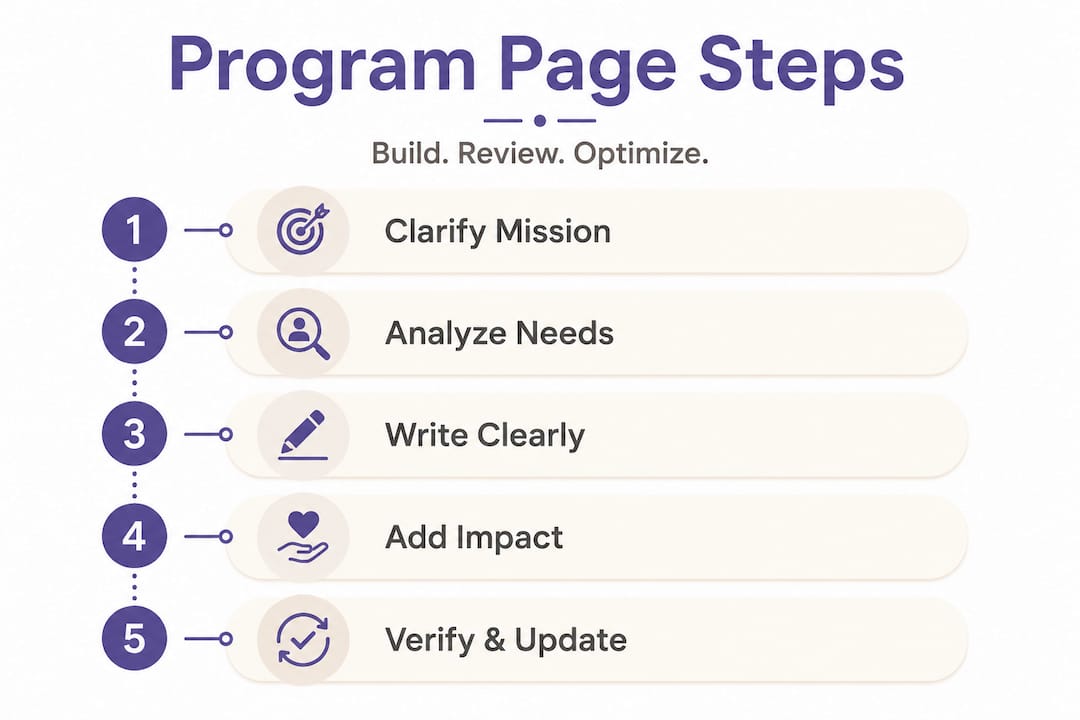
Start with a structured verification process before you publish anything new. Run a Go/No-Go check that asks: Does this program align with our mission? Does it avoid unnecessary duplication? Is the operational detail sufficient for a compliance review? If the answer to any of those is no, the content is not ready.
After publishing, gather feedback from three specific groups. Ask funders and major donors what questions the page leaves unanswered. Ask auditors or board members whether the operational detail is sufficient. And wherever possible, ask program participants whether the description accurately reflects their experience.
Failing to update program and financial data regularly weakens page reliability and donor trust over time. Set a calendar reminder to review your program metrics, staffing information, and cost data at least twice per year.
You should also apply SEO strategies to make sure people can find your page. Many nonprofits overlook this entirely, limiting their reach and engagement. Use keywords your target population and donors actually search for. Structure your page with clear headings that search engines can index. Ensure the page loads quickly and is accessible on mobile devices.
Pro Tip: Use Google Search Console (free) to see which search queries are already bringing people to your website. Those queries will tell you exactly what language to use in your program descriptions to match how your audience thinks.
My perspective on program pages that actually hold up
I’ve reviewed a lot of nonprofit websites over the years, and the pattern is almost always the same. The program services page looks polished at first glance, but the moment you ask a specific question, whether that’s “how many people do you actually serve?” or “what does enrollment look like?”, the page goes silent.
In my experience, operational clarity is not the enemy of donor engagement. It is the foundation of it. Donors who understand exactly what their money funds are far more likely to give again. Donors who encounter vague language and inspiring but unverifiable claims tend not to return.
I’ve seen program pages fail compliance audits not because the programs were flawed, but because the documentation on the page was so general that auditors couldn’t confirm the programs actually served the charitable class described in the organization’s tax-exempt filing. That’s an entirely avoidable problem.
What I tell every nonprofit leader I work with is this: treat your program services page as a living operational document, not a one-time publishing event. The organizations that update their pages regularly, with real data, real staffing changes, and honest financial information, are the ones that build lasting funder relationships. That level of transparency is what separates the nonprofits that grow from the ones that plateau.
— Matt
Ready to build a program page that earns trust
Your program services page is one of the most consequential pages on your website. When it’s built well, it tells donors, funders, auditors, and the communities you serve that your organization is serious about its mission and accountable for its results.
At Nonprofit-webdesign, we’ve helped nonprofits build professional, accessible, and search-optimized websites since 2005. If your current site isn’t presenting your programs in a way that builds confidence and drives support, our nonprofit website redesign services are designed specifically for organizations like yours. From structure and layout to compliance-ready content design, we handle the technical work so you can stay focused on your mission. Explore our support and care plans for ongoing help keeping your program pages current and performing.
FAQ
What should a nonprofit program services page include?
A strong program services page includes a clear purpose statement, target population, delivery model, staffing roles, cost structure, and measurable outcomes for each program. Funders and auditors also expect program logic model documentation mapping inputs to outcomes.
How often should you update a nonprofit program page?
You should update your program services page at least twice per year to reflect current data, staffing, and financials. Outdated program information erodes donor trust and can create compliance gaps during audits.
Can a program services page help with grant applications?
Yes. A well-documented program page gives grant reviewers a clear picture of your operational readiness and impact. Pages that include verifiable metrics, cost structures, and delivery models make the grant writing process significantly faster.
What is a program logic model and why does it matter?
A program logic model maps the inputs, activities, outputs, and outcomes of a program in a logical sequence. It helps funders verify that your program design makes sense and that your expected results are realistic and measurable.
How do you avoid duplicating local services on your program page?
Conduct a community ecosystem assessment before publishing any program description. If similar services exist nearby, explain how your program differs or how you collaborate with existing providers to fill a specific gap.