

Search engine optimization is not a commercial luxury reserved for online retailers or tech startups. Understanding the role of SEO for nonprofit websites means recognizing that every day your mission goes undiscovered in search results is a day you miss a potential donor, volunteer, or person who needs your services. Organic search is one of the most cost-effective discovery channels available to nonprofits, and unlike paid ads, it does not go dark the moment your budget runs dry. This guide walks you through the mechanics, strategies, and real-world outcomes that make SEO a long-term foundation for nonprofit impact.
Table of Contents
- Key Takeaways
- How SEO connects your mission to the right people
- Technical SEO foundations every nonprofit needs
- SEO strategies tailored for nonprofit audiences
- Measuring what matters for nonprofit SEO
- My honest take on where nonprofits go wrong with SEO
- Ready to build an SEO-ready nonprofit website?
- FAQ
Key Takeaways
| Point | Details |
|---|---|
| SEO drives mission visibility | Targeting the right keywords connects supporters, donors, and service users to your cause at the moment they search. |
| Technical foundations matter | Crawlability, metadata, and mobile optimization determine whether search engines can find and rank your pages. |
| Multiple audiences need distinct strategies | Donors, volunteers, and service seekers use different search terms and require tailored content to convert. |
| Conversions outrank rankings | Measuring donations and volunteer signups from organic traffic reveals true SEO success for nonprofits. |
| AI visibility is an emerging priority | Structured data and clear metadata now influence whether AI-powered search engines cite your organization. |
How SEO connects your mission to the right people
Think about what happens when someone decides to donate to a food bank, volunteer at an animal shelter, or find mental health resources in their city. They open a search engine and type a question. Mission-driven search queries route users directly to nonprofit program and donation pages, but only if those pages are optimized to appear in results.
This is the core function of search engine optimization (SEO) for nonprofits: making sure your programs, services, and calls to action show up when the people who care about your cause are actively looking. It is sometimes called “organic search strategy” in broader digital marketing discussions, but the principle is the same regardless of the label. You create content and structure your website so search engines understand what you offer and show it to relevant audiences.
For nonprofits, this works across several distinct conversion actions:
- Donation pages targeted to searches like “donate to children’s literacy programs” or “support local food pantry”
- Volunteer sign-up pages optimized for queries like “volunteer opportunities near me” or “weekend volunteer work in [city]”
- Program pages answering questions from service users like “free legal aid for low-income families in [county]”
- Cause education content that builds awareness among people researching issues your organization addresses
Internal linking plays a critical role here. When a blog post educating readers about food insecurity includes a clear link to your donation page, you guide motivated readers toward taking action. This is the difference between a website that informs and one that converts.
Pro Tip: When mapping your keyword strategy, start by listing every question your beneficiaries, donors, and volunteers might type into Google. Those questions are your content brief.
Unlike paid advertising, organic presence avoids temporary visibility loss when campaigns end. A well-optimized program page continues to attract visitors months or years after it is published, making SEO one of the most sustainable outreach investments a nonprofit can make.
Technical SEO foundations every nonprofit needs
You can produce outstanding mission-driven content, but if search engines cannot properly crawl and index your website, that content will not rank. Technical SEO is the infrastructure layer that makes everything else work.
Here is a practical framework for the four most important technical areas:
-
Crawlability and indexability. Search engines send bots to read your website before they can rank it. Indexability depends on crawl accessibility and technical signals, so any page that cannot be crawled will not appear in search results. Check your "robots.txt
file carefully. Nonprofits sometimes accidentally block pages from crawling when trying to manage indexing, but the correct approach is a [noindex directive](https://www.clarigital.com/codex/seo/fundamentals/crawlability-indexation/) that allows crawling while preventing indexing. This distinction matters because blocking crawling viarobots.txt` does not guarantee a page stays out of results. -
Metadata and structured data. Title tags, meta descriptions, and schema markup tell search engines what each page is about. For nonprofits, structured metadata helps AI and machine learning systems curate and recommend your content accurately. A nonprofit event page marked up with Event schema, or a donation page with Organization schema, gives both search engines and AI tools the structured cues they need to surface your content correctly.
-
Mobile optimization. Google ranks pages based on their mobile version first. A donation form that is difficult to complete on a phone directly reduces your conversion rate and your ranking potential. Test every key page on multiple screen sizes before publishing.
-
Page speed. Fast, accessible websites improve Google rankings and keep users engaged long enough to take action. A slow-loading volunteer sign-up page loses visitors before they complete the form.
Pro Tip: Use Google Search Console’s Coverage report to identify any pages being blocked from indexing unintentionally. Fix those before investing in new content.
Nonprofits with limited technical staff can benefit from nonprofit website best practices that address these foundations without requiring a developer on staff.
SEO strategies tailored for nonprofit audiences
Nonprofits face a unique challenge that most commercial SEO guides overlook entirely. Each audience requires tailored keyword and content strategies to address their unique queries and conversion goals. A donor searching for a trustworthy organization to fund uses completely different language than a service user looking for emergency housing assistance.
Here is how to approach each audience:
- Donors: Focus on trust signals and mission clarity. Keywords like “reputable [cause] charities,” “[city] nonprofit donation,” and “[organization name] impact report” align with donor intent. Pair these with transparent financial and program pages.
- Volunteers: Target action-oriented phrases. “Volunteer for [cause] in [city]” and “weekend volunteering opportunities” reflect the intent of people ready to commit time. Dedicated volunteer landing pages with clear sign-up forms convert this traffic.
- Service users: Prioritize hyper-specific, need-based queries. “Free meals [city],” “emergency rental assistance [county],” and “[program name] eligibility” match what people in crisis type. These pages should load fast and be written in plain language.
- Cause-curious supporters: Target awareness-stage searches like “why is food insecurity increasing” or “how does foster care work.” Long-form educational content serves this audience and builds trust before they become donors or advocates.
Geo-specific and long-tail keywords
Most nonprofits serve defined geographic communities, which makes local SEO one of the highest-return strategies available. Location-specific content and profiles drive local discovery by connecting searches like “homeless shelter downtown [city]” to your organization specifically. Claim and fully complete your Google Business Profile, maintain consistent name, address, and phone (NAP) data across all directories, and create location-specific landing pages for each service area you cover.

Comparing content approaches by audience
| Audience | Search intent | Content type | Conversion goal |
|---|---|---|---|
| Donors | Trust and mission alignment | Impact reports, FAQs, cause stories | Donation page completion |
| Volunteers | Ready to act, seeking fit | Program descriptions, sign-up forms | Volunteer application submission |
| Service users | Immediate need | Program eligibility pages, resource lists | Contact form or phone call |
| Cause-curious | Learning and exploring | Blog posts, explainer pages, case studies | Newsletter subscription or social follow |
Building backlinks through mission storytelling
Credible backlinks from local news, partners, and educational institutions enhance nonprofit website authority significantly. Nonprofits have a natural advantage here. A compelling impact story shared with a local newspaper, a partnership announcement published by a university, or a resource guide linked by a government agency all generate the kind of authoritative backlinks that commercial businesses struggle to earn organically.
Measuring what matters for nonprofit SEO
Rankings are not the finish line. For nonprofits, the only metrics that truly matter are the ones tied to mission outcomes. Conversion optimization ensures visibility translates to real-world mission impact, which means tracking what people do after they arrive from organic search, not just how many show up.
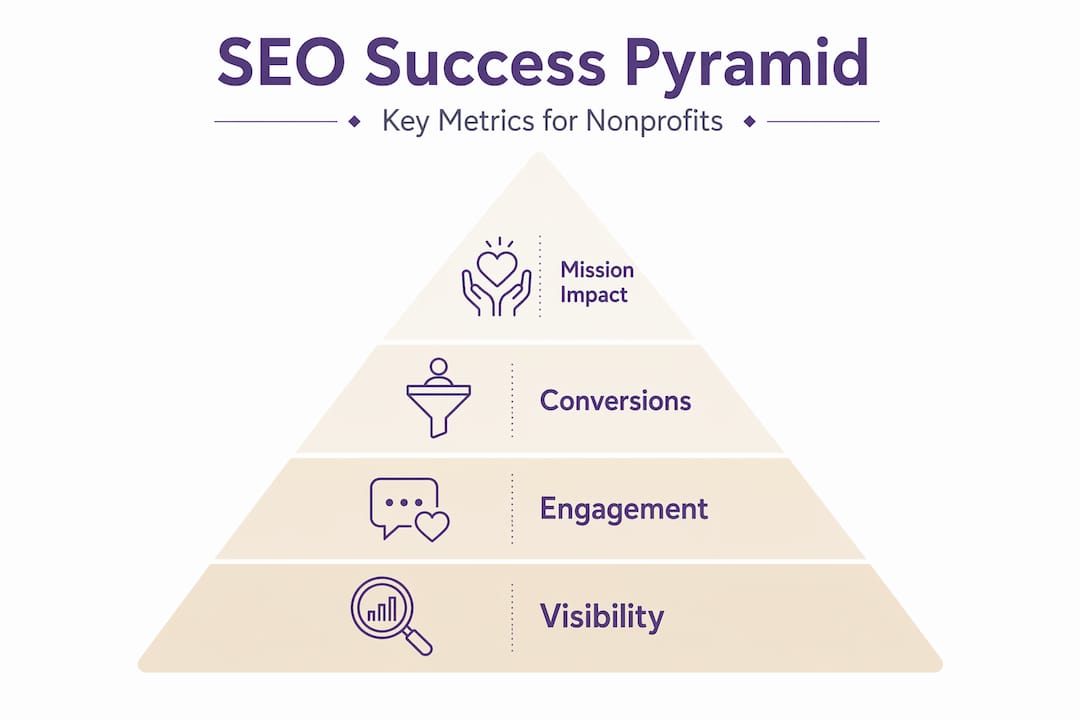
Here are the key measurements to track and what they tell you:
| Metric | What it measures | Why it matters for nonprofits |
|---|---|---|
| Organic donation conversions | Donations attributed to organic search sessions | Direct link between SEO and fundraising revenue |
| Volunteer sign-up rate | Form completions from organic traffic | Shows whether SEO brings mission-ready visitors |
| Pages per session | How deeply visitors explore your site | Indicates content quality and internal linking effectiveness |
| Bounce rate by landing page | Visitors who leave without taking action | Reveals mismatches between search intent and page content |
| Keyword ranking movement | Position changes for target terms over time | Tracks long-term SEO trajectory and competitive positioning |
Google Search Console shows which queries bring visitors to your site, and it is free. Google Ad Grants, the program that gives qualifying nonprofits up to $10,000 per month in free search advertising, also provides keyword performance data that directly informs your organic strategy. Running both in parallel gives you a fuller picture of which search terms drive real engagement.
Integrating your SEO insights with your broader nonprofit digital outreach strategies prevents your search efforts from existing in a silo. When your social media, email campaigns, and SEO all reinforce the same messaging and conversion paths, each channel amplifies the others.
Pro Tip: Set up a dedicated goal in Google Analytics for donation page completions and volunteer form submissions. Then create a custom report filtered by “organic search” traffic source. You will see the direct dollar and volunteer value generated by your SEO work.
My honest take on where nonprofits go wrong with SEO
I have worked with dozens of nonprofits over the years, and I see the same pattern repeatedly. Organizations invest time in writing blog content but structure their websites in ways that make it nearly impossible for search engines to understand the hierarchy between their programs, their impact stories, and their conversion pages. They get traffic. It just never converts.
The other mistake I see constantly is treating AI and answer engine visibility as a future concern. It is not. When someone asks an AI assistant which local organizations accept clothing donations, the answer that surfaces comes from the organization whose website has clean structured data and well-labeled content. If your schema is missing or your program descriptions are buried in PDFs, you will not make that list.
What I have found actually works is starting with the conversion path and building backward. Decide what you want a donor, volunteer, or service user to do, then build the content chain from search query to landing page to action. Every piece of content should serve that chain. An awareness article about food insecurity should link to your food pantry program page. That program page should link to your donation form and your volunteer sign-up. That logical sequence, reinforced by clear metadata and fast load times, is what turns search traffic into mission outcomes.
I also believe nonprofits dramatically underestimate the power of their own stories as an SEO asset. A detailed case study about how your organization helped a specific family in a specific neighborhood does three things at once: it attracts long-tail search queries, it builds emotional trust with potential donors, and it earns backlinks from community organizations and local press. Very few commercial websites can produce content like that. It is a real competitive advantage.
— Matt
Ready to build an SEO-ready nonprofit website?
At Nonprofit-webdesign, we have spent nearly two decades helping nonprofits build websites that do more than look good. They rank, they convert, and they grow your mission. Whether you need a full nonprofit website redesign built for technical SEO from the ground up, or you need help connecting your donation funnel optimization to your organic search strategy, our team knows the specific challenges nonprofits face with limited budgets and high-stakes visibility goals.
We build with accessibility, mobile performance, and search engine indexing built into the architecture, not added as an afterthought. If your current website is not bringing in the donors, volunteers, and community members your mission deserves, it may be time to take a closer look at what search engines see when they visit your site.
FAQ
What is the role of SEO for nonprofit websites?
SEO helps nonprofit websites appear in search results when donors, volunteers, and service users are actively searching for causes, programs, or giving opportunities. It drives sustained, cost-free organic traffic that supports mission impact over the long term.
How does metadata affect nonprofit website SEO?
Metadata including title tags, meta descriptions, and schema markup helps search engines and AI systems understand what each page is about. Consistent schema and provenance cues are now critical for nonprofits to appear in AI-powered search results and recommendations.
Is local SEO worth the effort for nonprofits?
Yes. Nonprofits serving specific geographic communities gain significant visibility by optimizing for location-specific keywords, maintaining an accurate Google Business Profile, and creating content that names the communities they serve. Local searches often signal high intent from people ready to donate or volunteer.
How should nonprofits measure SEO success?
Go beyond keyword rankings. Track organic conversions like donation completions and volunteer sign-ups, monitor pages per session to assess content quality, and use Google Search Console to understand which queries actually bring visitors to your site.
Can nonprofits do SEO without a large budget?
Absolutely. The most powerful nonprofit SEO tactics, including content creation, internal linking, metadata optimization, and Google Business Profile management, require time rather than significant financial investment. Google Search Console and Google Analytics are free tools that provide the data you need to make informed decisions.