

Your nonprofit’s website is likely getting more mobile visitors than you realize. Understanding why mobile-friendly websites matter for nonprofits goes deeper than having a site that “works on phones.” The real issue is that 53% of nonprofit website visits now come from mobile devices, yet most organizations see significantly lower donation revenue from those visitors. That gap is not a donor problem. It is a design problem, and closing it can meaningfully change your fundraising outcomes.
Table of Contents
- Key Takeaways
- Mobile internet trends nonprofits can’t ignore
- The mobile giving gap explained
- What true mobile optimization actually means
- Practical steps to improve mobile performance
- Benefits beyond the donation button
- My honest take on mobile and nonprofit fundraising
- Ready to close your mobile giving gap?
- FAQ
Key Takeaways
| Point | Details |
|---|---|
| Mobile traffic dominates | Over half of nonprofit website visits come from mobile, but donations lag far behind desktop giving. |
| Design drives the gap | Poor mobile UX, slow load times, and cumbersome forms are the primary reasons mobile visitors don’t convert. |
| Mobile-first differs from responsive | True mobile optimization means building donor journeys for small screens first, not shrinking desktop pages. |
| Quick wins exist | Digital wallets, single-page donation forms, and faster load times can increase mobile conversion quickly. |
| Benefits extend beyond giving | Mobile optimization improves SEO rankings, donor retention, and access to younger supporter segments. |
Mobile internet trends nonprofits can’t ignore
The numbers tell a clear story. 62% of all global web traffic now occurs on mobile devices, and nonprofit audiences reflect that trend or exceed it. Your supporters are not sitting at desks when they encounter your cause. They are scrolling during a commute, watching a video on their couch, or responding to a social post on their lunch break.
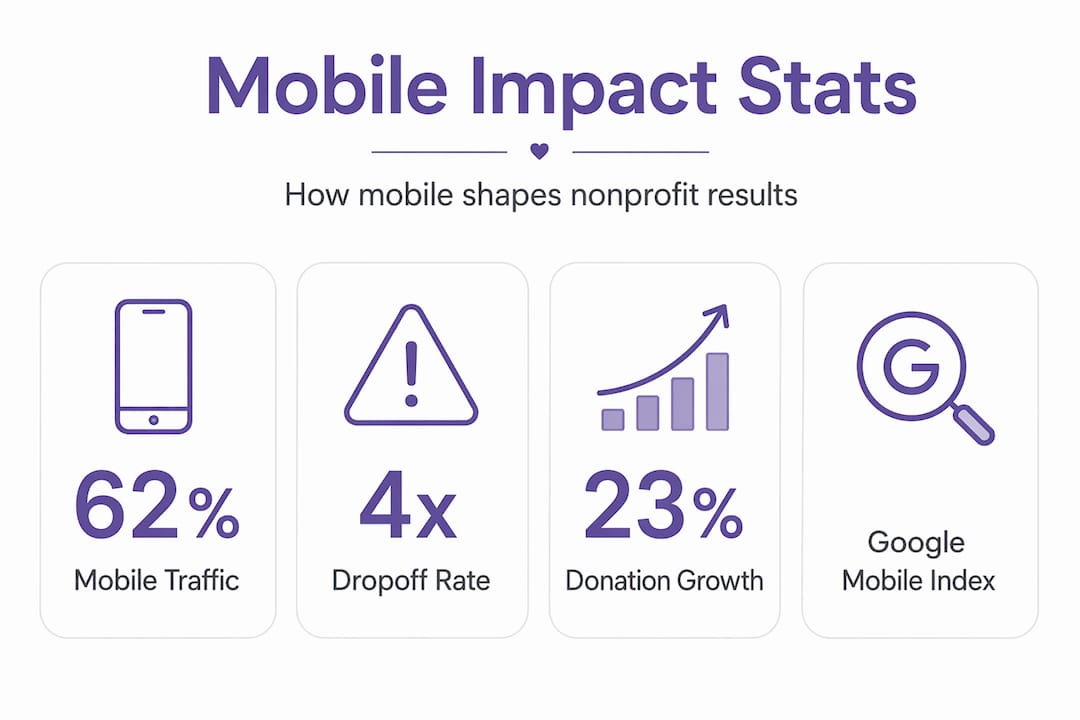
Demographic trends make this even more pressing. Younger donors, particularly those under 40, have grown up with smartphones as their primary screen. They expect experiences that feel native to their devices. A site that requires pinching, zooming, or waiting more than three seconds to load signals organizational carelessness, not technical limitation. These visitors leave and often don’t come back.
The importance of mobile websites for nonprofits also extends into giving channels beyond your site itself:
- SMS campaigns achieve 98% open rates, making text-to-give one of the highest-engagement fundraising tools available.
- Social media fundraising happens almost entirely on mobile, and your landing pages need to hold up when donors tap through from Instagram or Facebook.
- Email appeals are opened on phones at rates exceeding 50%, meaning the donation page your email links to must work flawlessly on a small screen.
Each of these channels flows toward your website. If the destination fails the mobile experience, the entire campaign suffers.
The mobile giving gap explained
Here is the uncomfortable truth: the average mobile gift is $76, compared to $145 on desktop. That is not because mobile donors are less generous. It is because mobile donation flows are harder to complete, and donors give up or give less when the process creates friction.
“The gap between mobile traffic and mobile revenue is structural, reflecting poor mobile design rather than donor commitment.” — DMNews
Friction in giving takes several forms. Slow pages are the most common culprit. A mobile visitor who waits more than three seconds for your donation page to load is statistically likely to abandon it entirely. You can learn more about this on the Nonprofit-webdesign article on page speed and donations, which details how load time directly reduces conversion rates.
Beyond speed, these barriers consistently hurt mobile donation rates:
- Long, multi-step forms that require typing credit card numbers, billing addresses, and personal details on a small keyboard
- Desktop-style navigation that forces mobile users to scroll sideways or tap tiny links
- Pop-ups and overlays that appear immediately and block the content donors came to see
- Non-mobile payment options that ignore the digital wallets donors already have on their phones
- Confusing confirmation flows that leave donors unsure whether their gift was processed
Each barrier compounds the others. A donor who hits two or three of these obstacles in a single visit is unlikely to complete a gift regardless of their intention. The mobile-friendly design for fundraising question is not just about aesthetics. It is about removing every unnecessary step between generosity and completed transaction.
What true mobile optimization actually means
Responsive design is a starting point, not a finish line. A responsive site adjusts its layout to fit different screen sizes, which is necessary but not sufficient for the mobile optimization for charities that actually moves the needle.
True mobile optimization means designing the donor journey with a small touchscreen as the primary context. Here is what that looks like in practice:
- Mobile-first design strategy. Build and test your donation flow on a phone before considering how it looks on a large monitor. This reverses the typical workflow and forces decisions that favor the mobile experience.
- Digital wallet integration. Only 47% of nonprofits accept Apple Pay and 40% accept Google Pay, despite these options eliminating the biggest friction point in mobile giving. A donor who can complete a gift with Face ID and two taps is far more likely to follow through than one who must type 16 digits on a phone keyboard.
- Single-page donation forms. Single-page checkouts with fast confirmation screens boost both completion rates and recurring gift enrollment. Reduce form fields to the minimum needed to process a transaction.
- Thumb-friendly navigation. Placing menus within the thumb zone and using large, well-spaced buttons reduces mis-taps and frustration. The top-right corner of a phone screen is the hardest spot for most people to reach one-handed.
- Optimized images and minimal scripts. Use compressed WebP images and eliminate heavy scripts that delay rendering. Every second you shave off load time protects your conversion rate.
- Mobile-native thank-you pages. A fast, warm confirmation screen after a gift is given is not just good manners. Immediate thank-you experiences have a measurable effect on whether first-time donors become recurring supporters.
Pro Tip: Test your donation form on an actual phone, not just a browser’s mobile preview mode. Real device testing reveals friction points that browser simulations miss, including keyboard behavior, tap accuracy, and load time over cellular networks.
The donation funnel optimization needed for nonprofits is detailed work, but the payoff scales directly with your traffic volume.

Practical steps to improve mobile performance
Knowing what good looks like is one thing. Getting there requires a structured approach. These steps reflect what the benefits of responsive design for nonprofits look like when applied as an ongoing practice rather than a one-time project.
- Audit your current mobile experience. Use Google’s Mobile-Friendly Test and PageSpeed Insights to get a baseline score. Review Core Web Vitals specifically, as Google uses these metrics to rank your pages.
- Evaluate your donation platform. Not all platforms are built equally for mobile. Prioritize platforms that support digital wallets, vertical form layouts, and minimal-step checkouts.
- Launch SMS fundraising campaigns. Text-to-give is a natural extension of mobile donation convenience, and with near-universal open rates, it reaches donors even when they are not actively visiting your site.
- Coordinate mobile messaging across channels. Your SMS appeal, social post, and email should link to the same optimized landing page. Inconsistent experiences confuse donors and reduce trust.
- Analyze behavior data by device type. Segment your analytics to compare mobile versus desktop conversion rates, time on page, and abandonment points. The data will show you exactly where mobile donors drop off.
Pro Tip: Set up a quarterly mobile audit as a standing item on your digital strategy calendar. Mobile UX standards evolve quickly, and a site that scored well 18 months ago may already feel dated to a donor using the latest smartphone.
The table below summarizes key audit areas and the tools to use for each:
| Audit area | Recommended tool | What to look for |
|---|---|---|
| Page speed | Google PageSpeed Insights | Core Web Vitals score, load time |
| Mobile usability | Google Search Console | Usability errors, tap targets |
| Donation form friction | Session recording tools | Drop-off points, form errors |
| Payment options | Manual review | Digital wallet availability |
| SMS engagement | Platform analytics | Open rate, conversion rate |
Benefits beyond the donation button
The impact of mobile web on donations is the most direct measure of ROI, but mobile optimization for charities creates advantages that extend throughout your organization’s digital presence.
Google indexes and ranks pages based on their mobile version, a practice known as mobile-first indexing. If your site performs poorly on mobile, it ranks lower in search results regardless of how it looks on a desktop. For nonprofits competing for visibility alongside hundreds of similar organizations, search ranking affects how many potential donors and volunteers ever find you in the first place.
The broader benefits of mobile-friendly nonprofit websites include:
- Longer site visits from supporters who can comfortably read about your mission without zooming or scrolling awkwardly
- Better donor retention because a smooth mobile experience signals organizational professionalism and builds trust
- Greater reach among younger donors who expect seamless mobile experiences and will disengage from organizations that do not provide them
- Stronger brand perception in a sector where digital credibility increasingly shapes public trust
These gains compound. A nonprofit that ranks well, loads fast, and converts mobile visitors builds a sustainable digital presence that supports every campaign it runs. The best practices for nonprofit websites always treat mobile performance as a foundation, not a feature.
My honest take on mobile and nonprofit fundraising
I’ve worked with nonprofits long enough to see a clear pattern. Organizations that treat mobile optimization as a technical checkbox tend to make incremental improvements that don’t move their fundraising numbers. Organizations that treat it as a core donor experience question see different results.
The mistake I see most often is conflating responsiveness with optimization. A site can pass Google’s mobile-friendly test and still lose 60% of its donation attempts to a clunky form or a two-second delay. Mobile-first fundraising means rethinking the entire donor journey from the perspective of someone with a four-inch screen, limited patience, and good intentions. That person deserves a frictionless path to giving.
I’ve also seen nonprofits resist digital wallet integration because it feels complicated to set up. In my experience, the setup cost is almost always outweighed within the first campaign that uses it. Donors who can give with a thumbprint are not just more likely to complete the gift. They are more likely to give again.
My advice is to treat your mobile experience the same way you treat your major donor relationships: with attention, intention, and a willingness to continuously improve. The organizations that do this are the ones closing the giving gap.
— Matt
Ready to close your mobile giving gap?
If your website is sending mobile visitors away before they have the chance to give, Nonprofit-webdesign can help you change that. Since 2005, the team has specialized in purpose-driven web design built specifically for nonprofits, with mobile performance and donor conversion at the center of every project.
Whether you need a full nonprofit website redesign built around mobile-first principles or targeted improvements to your donation funnel, Nonprofit-webdesign offers affordable solutions that fit the realities of nonprofit budgets. The team integrates mobile optimization, SEO, and accessibility into a single, coherent strategy so your site works as hard as your mission demands. Get in touch to discuss what your organization needs and see what a mobile-optimized donor experience can do for your fundraising results.
FAQ
Why do nonprofits need mobile-friendly websites?
Over half of nonprofit website traffic comes from mobile devices. Without a mobile-optimized experience, organizations lose potential donors who abandon slow pages or complicated donation forms before completing a gift.
What is the mobile giving gap?
The mobile giving gap refers to the disparity between mobile traffic volume and mobile donation revenue. The average mobile gift is $76 compared to $145 on desktop, a difference driven largely by poor mobile UX rather than donor intent.
How does mobile optimization improve nonprofit fundraising?
Faster load times, digital wallet support, and single-page donation forms reduce friction in the giving process. Removing these barriers increases the percentage of mobile visitors who complete a donation.
Does mobile optimization affect nonprofit search rankings?
Yes. Google uses mobile-first indexing, meaning it ranks your pages based on how they perform on mobile. A poor mobile experience directly reduces your visibility in search results, limiting how many new supporters find your organization.
What is the easiest first step to improve mobile performance?
Run your site through Google’s PageSpeed Insights and Mobile-Friendly Test to identify specific issues. Focus first on load speed and donation form usability, as these have the most direct effect on conversion rates.