

Many California nonprofits lose months to IRS delays because their mission statement webpage fails to clearly communicate charitable purpose. When you create a nonprofit mission statement webpage without understanding what the IRS actually reviews, vague language becomes a costly mistake. This guide walks you through every step: from understanding legal requirements and drafting compliant language, to designing a page that converts visitors into donors and volunteers. Whether you are launching your first 501©(3) or refreshing an existing site, these practical steps will help you build a mission page that works legally and engages your community.
Table of Contents
- Understanding the essentials of a nonprofit mission statement
- Preparing to write your mission statement: clarifying focus and compliance
- Crafting your nonprofit mission statement webpage content for impact and clarity
- Designing and integrating your mission statement webpage effectively
- Validating your mission statement for legal compliance and long-term alignment
- Rethinking mission statements: beyond compliance to lasting organizational identity
- Professional nonprofit web design to amplify your mission statement
- Frequently asked questions
Key Takeaways
| Point | Details |
|---|---|
| Clarity prevents delays | Clear and compliant mission statements avoid IRS application delays and legal issues. |
| California legal alignment | Your mission must match your articles and bylaws per California nonprofit laws and IRS rules. |
| Concise and engaging | Keep mission statements under 25 words on your website homepage for immediate visitor impact. |
| Collaborate and test | Engage board, staff, and stakeholders in drafting and testing mission statements for clarity and durability. |
| Web design matters | Place mission statement prominently with impactful visuals and calls to action for greater engagement. |
Understanding the essentials of a nonprofit mission statement
To create a web page that effectively displays your mission, you first need to understand what a compliant, strong nonprofit mission statement actually requires. This is not just a marketing exercise. Your mission statement is a legal document that guides board decisions, defines your tax-exempt purpose, and directly influences whether the IRS approves your 501©(3) application.
According to nonprofit legal experts, vague mission statements cause IRS 501©(3) delays because they fail to demonstrate a clear charitable purpose. The IRS needs to see exactly who you serve, what activities you conduct, and why those activities qualify as charitable, educational, religious, or another recognized exempt category.
For California organizations specifically, the stakes are even higher. California Corporations Code §5151 requires nonprofit bylaws to specify board structure that aligns with the mission stated in the articles of incorporation. A mismatch between your mission statement and your governing documents can stall both state registration and federal tax-exempt status.
A strong mission statement must address these core elements:
- Who you serve: The specific population or community benefiting from your work
- What you do: The activities, programs, or services your organization provides
- Why it matters: The broader social, educational, or charitable purpose driving your work
- How you operate: The general approach or method your organization uses to deliver its mission
Following nonprofit website best practices from the start ensures your mission statement page serves both legal and engagement purposes from day one.
Preparing to write your mission statement: clarifying focus and compliance

With a solid understanding of foundational requirements, the next step is drafting your mission statement precisely and strategically. Preparation is where most nonprofits either get it right or set themselves up for problems later.
Follow these steps before you write a single word of your mission statement:
-
Identify your exempt purpose. The IRS recognizes specific categories including charitable, educational, scientific, religious, and literary purposes. Your mission must tie directly to one or more of these. If your activities do not clearly fit a recognized category, you need to refine your focus before drafting.
-
Define your beneficiary population concretely. “Helping people” is not enough. “Providing free legal aid to low-income residents of Los Angeles County” is. Specificity protects you legally and makes your mission more compelling to supporters.
-
Review your articles of incorporation. Your mission statement must match the language in your founding documents. Inconsistencies between your website, your bylaws, and your articles of incorporation create red flags during IRS review.
-
Align with your bylaws. As Chisholm Law Firm advises, your mission statement acts as the foundation of your organization, explaining who you serve, what you do, how you do it, and why. Every governance document should reflect that foundation consistently.
-
Draft multiple versions. Write five to ten variations of your mission statement. Test each one with board members, staff, and community stakeholders who are not deeply familiar with your work. If they cannot explain your mission back to you after reading it once, revise it.
-
Prioritize legal clarity over brevity. As Exempt Nexus explains, mission statements must include your purpose, activities, and beneficiaries with IRS legal compliance prioritized over brevity. A slightly longer statement that passes IRS review is far better than a punchy tagline that triggers a request for more information.
Pro Tip: Once your mission statement is legally sound, you can create a shorter display version for your homepage and a fuller version for your About page and IRS filings. These are two different tools serving two different audiences. Good seo strategies for nonprofits actually reward this layered approach by giving search engines more relevant content to index.
Crafting your nonprofit mission statement webpage content for impact and clarity
Once your mission content is crafted, the next focus is designing the webpage to maximize engagement and clarity. The best mission statement in the world loses its power if visitors cannot find it, read it, or connect with it emotionally.
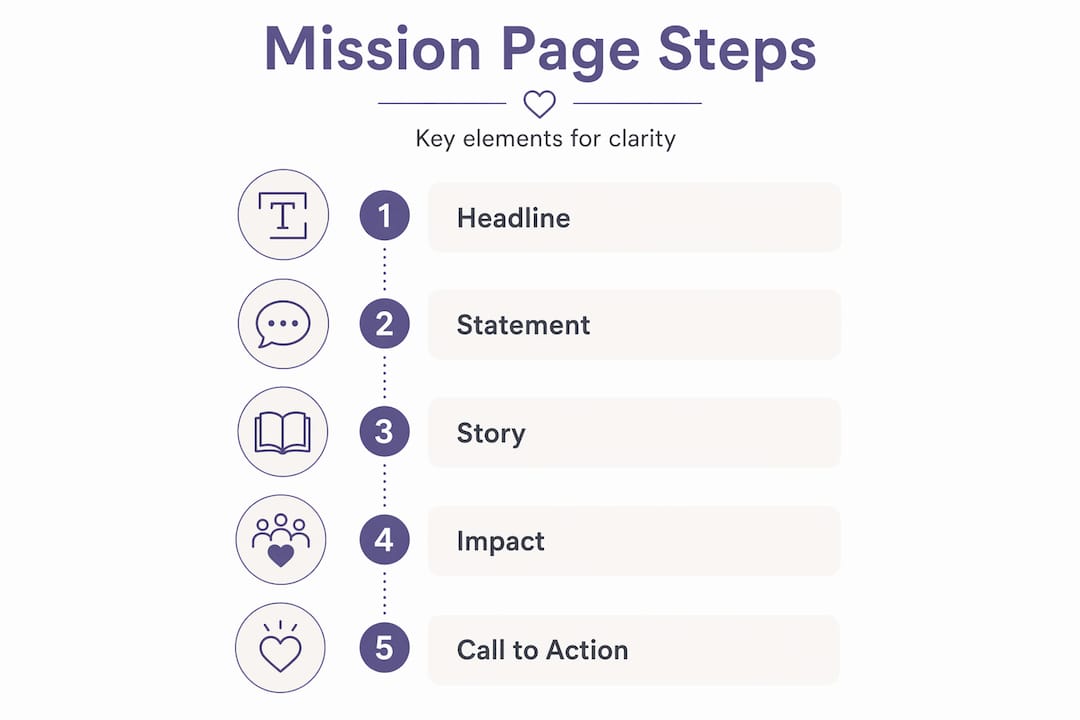
Here are the core elements of an effective mission statement webpage:
- Keep display text under 25 words. Website design guidance for 2026 recommends nonprofit mission statements be concise, placed above the fold, and supported by impact statistics to engage visitors quickly. Your homepage display version should be short enough to read in under five seconds.
- Back your mission with real numbers. A statement like “We provide meals to food-insecure families” becomes far more powerful when paired with “Over 12,000 meals delivered in 2025.” Impact statistics convert passive readers into active supporters.
- Add calls to action near your mission. Donation and volunteer buttons placed directly below your mission statement create a natural path from inspiration to action. Do not make visitors search for how to help.
- Use authentic photography. Stock photos undermine credibility. Images of your actual team, clients, or programs reinforce that your mission is real and active. Visitors notice the difference.
- Design for accessibility. High contrast text, readable font sizes (at least 16px), and alt text on images ensure your mission reaches every visitor, including those using screen readers or mobile devices.
| Webpage element | Purpose | Best practice |
|---|---|---|
| Mission headline | Communicate purpose instantly | Under 25 words, above the fold |
| Impact statistics | Build credibility and urgency | Use real, current numbers |
| Supporting imagery | Reinforce authenticity | Use original photos, not stock |
| Call to action buttons | Convert visitors to supporters | Place directly below mission text |
| Full mission statement | Provide legal and governance detail | Link to About or Mission page |
Pro Tip: Visit nonprofit publicity resources for guidance on how to frame your mission story for media and public audiences. The messaging principles translate directly to your webpage. You can also explore our nonprofit website design options to see how these elements come together visually, and check our nonprofit website FAQs for common questions about structure and content.
Designing and integrating your mission statement webpage effectively
With your mission now properly crafted and positioned, it is crucial to verify and maintain its alignment with legal requirements and organizational documents. But first, the design itself needs deliberate attention.
Follow these steps to integrate your mission statement into your website effectively:
-
Place your mission above the fold. Visitors should see your mission statement without scrolling. Website design experts recommend placing mission content prominently with complementary graphics and calls to action for donations and volunteering. If a visitor has to scroll to find your purpose, many will leave before they get there.
-
Choose a clean, readable font. Serif fonts like Georgia work well for formal mission statements. Sans-serif fonts like Open Sans or Lato are easier to read on screens. Avoid decorative fonts that sacrifice readability for style.
-
Compare your design approach. The table below outlines three common approaches and their tradeoffs.
| Design approach | Strengths | Weaknesses |
|---|---|---|
| Text on solid background | Maximum readability, fast loading | Can feel plain without strong typography |
| Mission text with adjacent image | Balances clarity and visual appeal | Requires strong, relevant photography |
| Text overlay on full-width photo | High visual impact | Risk of poor contrast and readability issues |
-
Repeat your mission on key pages. Your homepage, About page, and donation page should all reference your mission. Consistency reinforces your brand and ensures visitors encounter your purpose regardless of where they enter your site.
-
Test on mobile devices. More than half of nonprofit website visitors use smartphones. Your mission statement must be just as clear and actionable on a 375px screen as it is on a desktop. Our nonprofit website redesign services include mobile optimization as a standard component.
Validating your mission statement for legal compliance and long-term alignment
Having validated your mission both legally and organizationally, understanding new perspectives can enhance its impact and longevity. But before you publish anything, a compliance review is non-negotiable.
Here is what to check before your mission statement goes live:
- Verify word-for-word alignment. Your mission statement on the website must match the language in your articles of incorporation and bylaws. IRS reviewers examine mission alignment with bylaws and articles, and missing dissolution clauses or inconsistent language can stall applications.
- Include required legal clauses. Your governing documents must include clauses covering asset distribution upon dissolution. While these do not appear on your webpage, they must align with the purpose your webpage states.
- Secure official board approval. Your board must formally approve the mission statement before you file or publish it. Document this approval in meeting minutes. Board approval via minutes is an essential step before IRS Form 1023 submission.
- Track amendments carefully. If your mission scope changes significantly, you will need board approval and possibly amended articles of incorporation. Practitioners confirm that mission changes require board approval and may require formal amendments to founding documents.
- Schedule annual reviews. California nonprofits should review their mission statement at least once a year to confirm it still reflects actual activities and remains consistent with all governing documents.
Pro Tip: Keep a compliance checklist in your board meeting agenda. Reviewing mission alignment annually takes less than five minutes and prevents the kind of drift that creates expensive legal problems later. Our nonprofit compliance services can help you stay on top of these requirements.
Rethinking mission statements: beyond compliance to lasting organizational identity
Here is something most guides will not tell you: the nonprofits that struggle most with their mission statement webpages are not struggling with web design. They are struggling with organizational clarity. A confusing webpage is usually a symptom of a confusing internal understanding of purpose.
We have worked with California nonprofits since 2005, and the pattern is consistent. Organizations that treat their mission statement as a legal checkbox produce webpages that feel hollow. Organizations that treat their mission as a genuine operational guide produce pages that donors bookmark and share.
Audrey Chisholm explains that mission statements guide board decisions and reduce IRS rejections, and that vague language delays 501©(3) approval. But the deeper truth is that vague language usually reflects vague thinking. When board members cannot agree on who the organization primarily serves, that disagreement shows up in every grant application, every program decision, and yes, every webpage.
The most effective mission statements we have seen are written in plain language that a community member with no nonprofit background can understand immediately. They avoid jargon like “capacity building” or “systems change” in favor of concrete descriptions of real activities. They are specific enough to exclude activities the organization does not do, which is actually a strength, not a limitation.
Treat your mission statement as an operational playbook, not a slogan. When a new program idea comes to the board, the first question should be: does this align with our stated mission? If the answer requires a long debate, your mission statement is not doing its job. A well-written mission statement makes those decisions faster and protects the organization from scope creep that can jeopardize tax-exempt status.
Professional nonprofit web design to amplify your mission statement
Your mission statement is only as powerful as the platform presenting it. A well-written mission buried in a cluttered, hard-to-navigate website will not move donors or volunteers to act.
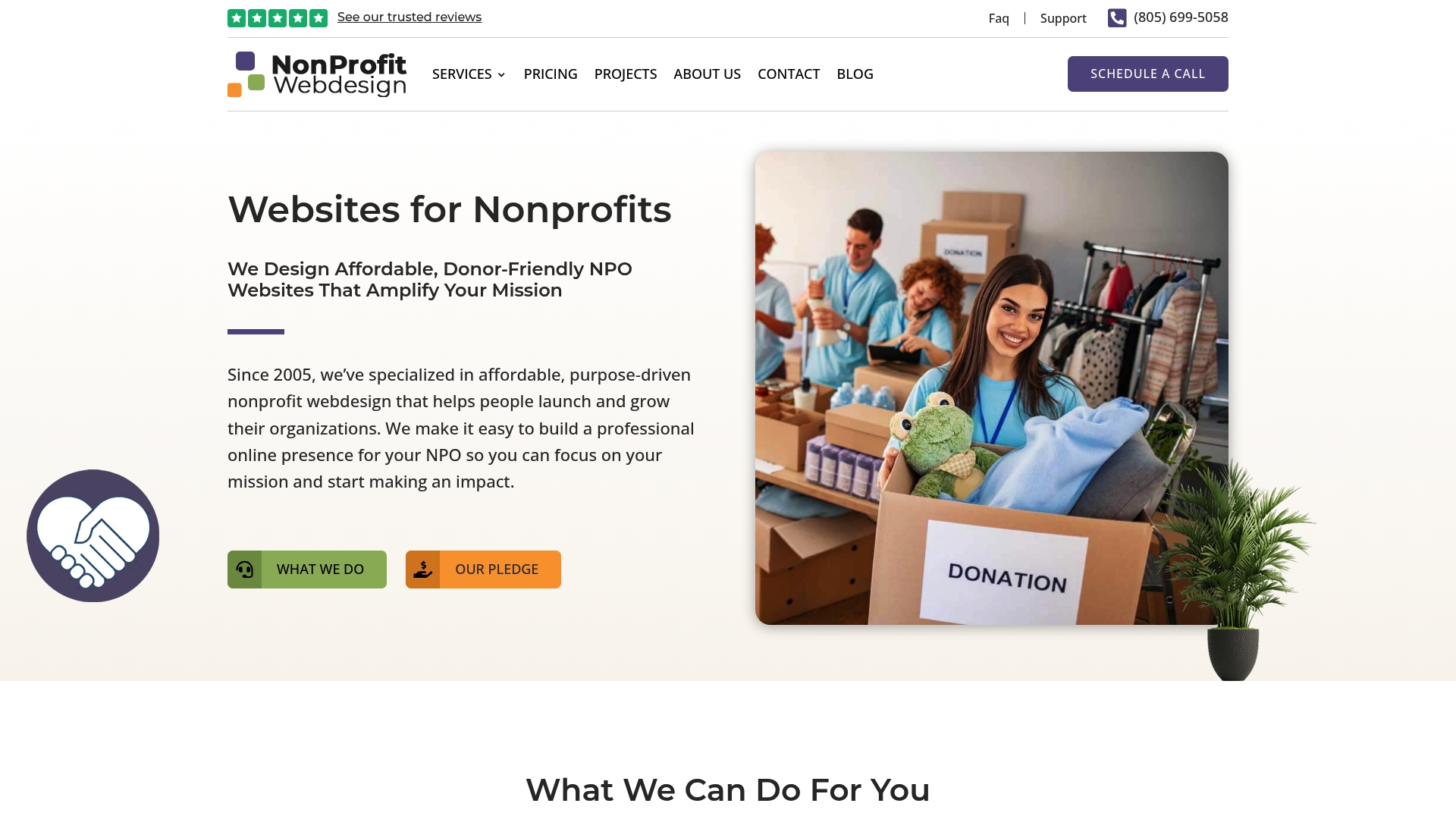
Since 2005, we have built affordable, purpose-driven websites for nonprofits across California and beyond. Our mission-focused website design services put your mission front and center, with accessible layouts, clear calls to action, and SEO-optimized content that helps supporters find you online. Whether you need a full website redesign or ongoing help keeping your content fresh and compliant, our ongoing support and care plans are built specifically for nonprofit teams who want to focus on their mission, not their website. Let us handle the technical side so you can focus on your community.
Frequently asked questions
How long should my nonprofit mission statement be for the website?
Aim for 25 words or less for your homepage display version, placed above the fold, while keeping a fuller version in your About page and governing documents that clearly states your purpose, services, and beneficiaries.
What happens if my mission statement is vague or unclear to the IRS?
Vague mission statements are a leading cause of IRS 501©(3) delays or rejections because they fail to clearly demonstrate a qualifying charitable purpose, which can cost your organization months of processing time.
Do I need board approval for my mission statement?
Yes, board approval via minutes is essential before filing or publishing your nonprofit mission statement, and this documentation must be in place before you submit IRS Form 1023.
How can I test if my mission statement is effective and durable?
Test five to ten versions externally with stakeholders by asking “What changes if we disappeared?” to confirm clarity and long-term relevance, ensuring your mission statement drafts hold up across different audiences and contexts.
Should my mission statement match my nonprofit’s articles of incorporation and bylaws?
Yes, your mission statement must align with bylaws and articles precisely, because inconsistencies between your website content and governing documents can trigger IRS questions and delay your tax-exempt approval.