

Your nonprofit’s website, social accounts, and email list are not marketing extras. They are the operational backbone of how you recruit volunteers, retain donors, and deliver your mission at scale. The role of online presence for nonprofits goes far beyond visibility. It determines whether a first-time visitor becomes a recurring donor or disappears after one visit. This guide breaks down the foundational elements every California nonprofit leader needs to build, protect, and measure a digital presence that actually drives impact.
Table of Contents
- Why online presence is central to nonprofit mission delivery
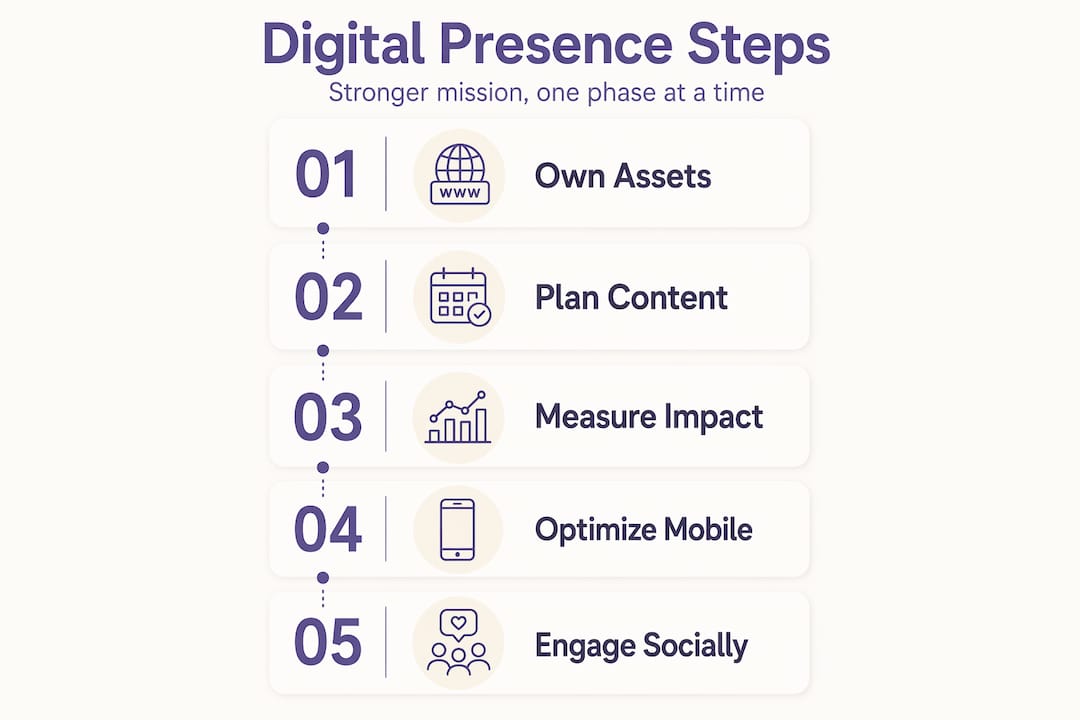
- Owning your digital foundations: domains, websites, and social accounts
- Strategic content planning: creating an editorial calendar that builds community
- Measuring what matters: tracking engagement beyond vanity metrics
- Optimizing for the mobile-first donor experience
- Using social media strategically to build relationships, not just reach
- Strengthening your nonprofit’s digital profile through small consistent improvements
- Why many nonprofits overlook the hidden power of their online presence
- Enhance your nonprofit’s impact with professional web design and digital strategy
- Frequently asked questions
Key Takeaways
| Point | Details |
|---|---|
| Online presence as mission infrastructure | Your nonprofit’s website and digital profiles are core to delivering your mission and engaging supporters. |
| Own your digital assets | Secure your domains and social accounts under organizational control to protect your brand and access. |
| Measure real impact | Track conversion events like donations and signups to evaluate your online presence effectiveness. |
| Optimize for mobile donors | Ensure your site loads fast and donation forms are simple to capture mobile supporter contributions. |
| Build trust with content | Consistently share authentic stories and plan your content to foster lasting community connections. |
Why online presence is central to nonprofit mission delivery
Most nonprofit leaders understand that being online matters. Fewer recognize that their online presence functions as infrastructure for mission delivery, not just a communications channel. When your website, email, and social platforms work together with consistent messaging, you create a system that guides supporters from first awareness to long-term commitment.
This matters because inconsistent messaging across platforms erodes trust. A donor who reads one story on your Instagram page and finds a contradictory narrative on your website will hesitate. Alignment across every digital touchpoint reinforces your credibility and makes your mission feel real and urgent.
Your nonprofit website as a central hub also enables measurable outcomes. Every donation click, newsletter signup, and volunteer application can be tracked, analyzed, and improved. That kind of accountability is not just useful for internal decision-making. It is increasingly expected by grant funders and major donors who want to see evidence that your organization manages resources and relationships well.
“A nonprofit’s online presence functions as the central hub for mission delivery, donor engagement, and advocacy — so the role of being online is not just awareness, but infrastructure that supports consistent messaging and measurable outcomes.”
Now that we understand online presence is mission-critical, let’s explore the foundational elements that nonprofits must secure.
Owning your digital foundations: domains, websites, and social accounts
One of the most preventable crises in the nonprofit sector is losing access to a domain or social account because a departing volunteer or contractor registered it under their personal credentials. As this risk is well documented, a well-meaning individual who sets up your accounts using a personal email can unintentionally hold your digital identity hostage when they leave.
Here is how to protect your organization’s digital assets from the start:
- Register all domains using a shared organizational email address, not a personal one.
- Use a reputable domain registrar and enable auto-renew to prevent accidental expiration.
- Grant social media access through platform delegation tools, never through shared passwords.
- Conduct a quarterly audit of who has admin access to every account and remove former staff or volunteers promptly.
- Store login credentials and account recovery information in a secure, shared password manager accessible to at least two organizational leaders.
Following nonprofit website best practices also means choosing hosting that provides SSL certificates, regular backups, and uptime monitoring. These are not technical luxuries. They are baseline requirements for any organization that collects donor data or processes online payments.
Pro Tip: Before your next board meeting, run a quick audit of every digital asset your organization owns. Confirm that no account is tied solely to a personal email address. This single step prevents one of the most common and costly digital mistakes nonprofits make.
With your digital foundations secure, it’s important to move beyond ad hoc posting to strategic content planning.
Strategic content planning: creating an editorial calendar that builds community
Posting only when you need donations is one of the fastest ways to train your audience to ignore you. Posting only for immediate needs leads to donor fatigue and low engagement. The solution is a content plan that balances impact stories with actionable requests.
A practical framework many nonprofits use is the 70/20/10 rule:
- 70% value-based content: Stories of impact, beneficiary spotlights, educational posts related to your cause, and behind-the-scenes updates that build emotional connection.
- 20% shared or community content: Relevant news, partner highlights, and community voices that position your nonprofit as part of a broader movement.
- 10% direct asks: Donation appeals, volunteer recruitment, and event promotions.
A shared editorial calendar keeps your email, social, and website content coordinated. When your newsletter references a story you posted on Instagram last week, and your website features the same campaign, the message compounds. Supporters encounter your mission from multiple angles, which builds familiarity and trust over time.
Explore nonprofit blog content strategies to see how consistent publishing also supports search visibility, bringing new supporters to your mission organically without paid advertising.

Pro Tip: Batch your content creation monthly. Spend two hours at the start of each month writing captions, drafting email subject lines, and scheduling posts. This prevents the “we haven’t posted in three weeks” panic that leads to rushed, off-brand messaging.
Planning great content requires measuring its real impact beyond superficial metrics.
Measuring what matters: tracking engagement beyond vanity metrics
Page views feel good. They tell you almost nothing useful. What you actually need to know is whether visitors are taking action. Measuring donation and signup clicks, not just traffic volume, is what separates organizations that grow from those that stagnate.
Set up conversion and attribution tracking to monitor specific actions on your site. This includes donation button clicks, form completions, and email list signups. Behavioral analytics tools show you exactly where users drop off during the donation process, which is often more valuable than knowing how many people visited.
Key metrics worth tracking:
- Donation conversion rate: What percentage of visitors who reach your donation page actually complete a gift?
- Form abandonment rate: At which field or step do users leave your volunteer or contact forms?
- Email click-through rate: Are your email subscribers engaging with your calls to action?
- Return visitor rate: Are people coming back, which signals genuine interest and community?
| Metric | What it measures | Why it matters |
|---|---|---|
| Donation conversion rate | Visitors who complete a gift | Reveals funnel effectiveness |
| Form abandonment rate | Where users exit forms | Identifies friction points |
| Email click-through rate | Subscriber engagement | Measures content relevance |
| Return visitor rate | Repeat site visits | Signals community loyalty |
Fixing donation funnel friction points is often the highest-return improvement a nonprofit can make. A 2% increase in donation conversion rate can mean thousands of dollars in additional annual revenue without spending a dollar more on outreach.
Pro Tip: Install a free heatmap tool on your donation page for 30 days. You will quickly see whether donors are scrolling past your ask, clicking the wrong buttons, or abandoning at the payment step. The data removes guesswork.
Understanding impact data informs optimizing for the growing mobile donor segment.
Optimizing for the mobile-first donor experience
Mobile revenue rose 48% in 2025, yet desktop visitors still donate more per visit on average. That combination tells you something important: mobile is where discovery and impulse giving happen, while desktop is where larger, more considered gifts occur. You need to optimize both, but mobile can no longer be an afterthought.
Speed is the starting point. Reducing page load time and simplifying donation steps directly increases mobile gift size and frequency. If your donation page takes more than three seconds to load on a phone, a significant portion of potential donors will leave before they ever see the ask.
Practical mobile optimization steps:
- Compress all images on your website, especially on donation and landing pages.
- Reduce your donation form to the minimum required fields: name, email, amount, and payment.
- Add Apple Pay, Google Pay, and PayPal as payment options to eliminate manual card entry.
- Test your entire donation flow on three different mobile devices before any campaign launch.
| Factor | Desktop behavior | Mobile behavior |
|---|---|---|
| Average gift size | Higher per visit | Lower but more frequent |
| Donation trigger | Research-driven | Impulse or social-driven |
| Form tolerance | Accepts longer forms | Abandons at 4+ fields |
| Payment preference | Credit/debit card | Digital wallets preferred |
| Optimization priority | Trust signals, detail | Speed, simplicity, one-tap payment |
Consider a website redesign if your current site was built more than four years ago. Mobile standards have shifted significantly, and older sites often carry structural issues that slow load times and frustrate donors on small screens.
Pro Tip: Use Google’s free PageSpeed Insights tool to test your donation page right now. A score below 70 on mobile means you are likely losing donors before they even read your appeal. Review best nonprofit website practices to address the most common speed and accessibility issues.
With core optimization in place, let’s review ways to build authentic connections through social media as part of your online presence.
Using social media strategically to build relationships, not just reach
The impact of social media on nonprofits is often measured in likes and shares. That is the wrong measure. Social media should build credibility and guide supporters toward email signups and deeper connections, not serve as your primary communication channel.
Effective social media strategy for nonprofits starts with focus. Trying to maintain a presence on five platforms with a small team produces mediocre results everywhere. Choose one or two platforms where your target audience is most active and show up consistently there.
Key practices that move social followers toward lasting relationships:
- Feature real beneficiaries, staff, and volunteers in your content. Authentic faces build trust faster than polished graphics.
- End every post with a clear, low-friction next step: read our story, join our newsletter, or watch this video.
- Use your social channels to close the loop after campaigns by publicly thanking donors and showing the impact of their gifts.
- Treat social as a bridge to your email list, which you own and control, not as your primary relationship channel.
Here is a simple process for batching social media content to stay consistent without burning out:
- Choose four to six content themes aligned with your mission and the 70/20/10 framework.
- Collect photos, quotes, and impact data from your program team at the start of each month.
- Write captions for two weeks of posts in one sitting, then schedule them using a free scheduling tool.
- Review performance at the end of each month and note which content types generated the most meaningful engagement.
Pairing social media with strong SEO strategies for nonprofits ensures that supporters who discover you through social can also find you through search, compounding your reach over time.
Strengthening your nonprofit’s digital profile through small consistent improvements
Digital presence is not built in a single website launch. Small, consistent improvements such as refreshing your homepage, tightening security, and refining communication channels add up to major impact over time. The organizations that grow their digital presence most effectively treat it as ongoing work, not a one-time project.
Practical areas to focus on:
- Homepage clarity: Can a first-time visitor understand your mission, your impact, and how to help within ten seconds? If not, simplify.
- Security and access audits: Update passwords, review admin permissions, and confirm SSL certificates are active at least twice a year.
- Communication channel review: Are your email unsubscribe rates climbing? That is a signal to reassess your content frequency and relevance.
- Community focus over trend-chasing: Platforms and algorithms change constantly. Your email list and website are the only digital assets you fully control.
Investing in nonprofit website design that prioritizes accessibility and clarity pays dividends beyond aesthetics. Accessible websites rank better in search, serve a wider audience, and signal to funders that your organization takes its public-facing work seriously. Pair that with ongoing web support to ensure your site stays secure, fast, and current without requiring constant internal attention.
Having built understanding and clarity, here is a unique perspective on the nonprofit online presence challenge.
Why many nonprofits overlook the hidden power of their online presence
After nearly two decades of working with nonprofits on their digital foundations, we have noticed a consistent pattern. Organizations invest heavily in program delivery and often treat their website and digital channels as secondary concerns, something to update when there is time. That approach has a real cost, and it is rarely measured.
The organizations that grow most sustainably are the ones that treat their website, email list, and social channels as core mission infrastructure, the same way they treat their office, their staff, and their financial systems. They budget for it, assign ownership, and review it regularly. They do not wait for a crisis, like a lost domain or a crashed donation page during a year-end campaign, to take it seriously.
The other pattern we see is an over-reliance on vanity metrics. A nonprofit celebrates 500 new Instagram followers while their donation page converts at under 1%. The followers feel like progress. The conversion rate is the actual problem. Shifting attention from what looks good to what drives mission outcomes is the single most important mindset change a nonprofit leader can make about their digital presence.
Your online presence is not a communications project. It is an operational system. Treat it like one. Review best nonprofit digital practices regularly, assign a staff member or partner to own it, and measure it against mission outcomes, not just traffic numbers.
Enhance your nonprofit’s impact with professional web design and digital strategy
Building and maintaining a high-performing online presence takes time, expertise, and consistent attention. Most nonprofit teams are stretched thin, and digital infrastructure often falls to whoever has a few spare hours.
Since 2005, we have helped nonprofits across California build purpose-driven websites that support their mission from day one. Our nonprofit website redesign services address speed, accessibility, and SEO so your site works as hard as your team does. We also offer ongoing support and care plans to keep your digital assets secure and current, and donation funnel optimization services that turn more visitors into committed donors. If you are ready to treat your online presence as the mission asset it truly is, we are here to help you build it right.
Frequently asked questions
Why is owning your domain and social media accounts important for nonprofits?
Owning these digital assets ensures your organization controls its online identity, preventing loss of access if staff or volunteers leave. As personal credentials create access risk, registering everything under organizational accounts is a non-negotiable foundation.
How can nonprofits measure the effectiveness of their online presence beyond page views?
By setting up conversion tracking to monitor actions like donations and newsletter signups, nonprofits can assess the true impact of their digital efforts. Behavioral analytics reveal drop-off points in the donation journey that page view data will never show.
What is the best social media strategy for nonprofits?
Focus on one or two platforms relevant to your audience, use authentic storytelling, and guide supporters to deeper engagement like email signups rather than relying solely on social. Building credibility through social works best when it connects followers to channels you own and control.
Why is mobile optimization crucial for nonprofit websites?
Because most donors now discover and engage with nonprofits on mobile devices, optimizing for speed, simplicity, and convenient payment options directly improves donation rates. Mobile revenue growth of 48% in 2025 confirms that mobile giving is no longer a secondary consideration.