
Getting a donor-focused nonprofit website that includes design, content, and ongoing support is often harder than it should be because most agencies either require long-term retainers or limit hands-on training for staff. Too many options force small charities into expensive hourly billing or skip over training, making staff dependent on outside help for basic updates. This comparison lets you weigh pricing structure, nonprofit experience, and support models among three agencies so you can choose the best fit for your team and budget.
Table of Contents
Nonprofit-webdesign
At a Glance
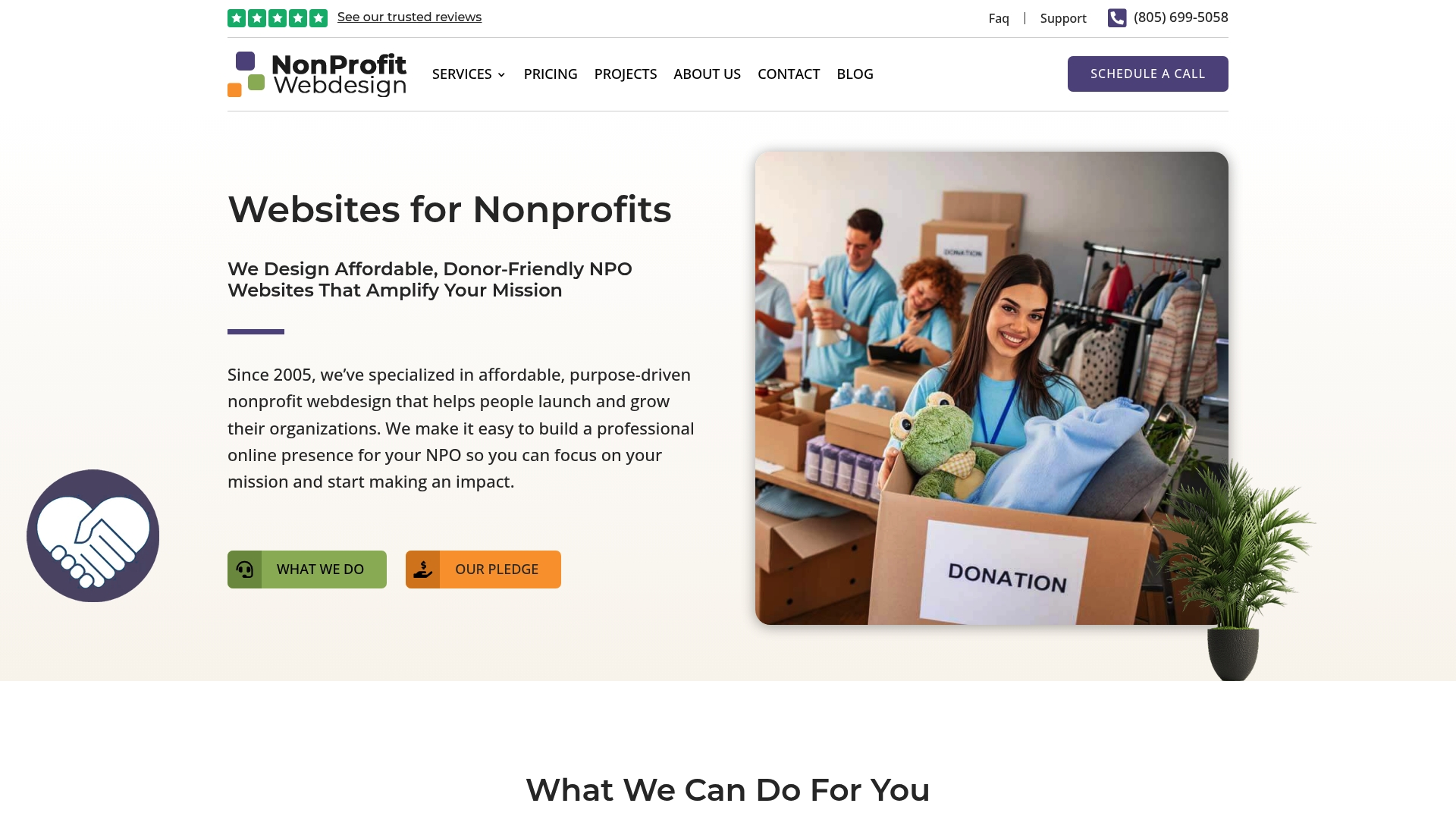
Packages start at approximately $999 for basic nonprofit websites, and the vendor reports operating since 2005 with a focus on donor-friendly design. The offering bundles design, content, SEO, hosting, and post-launch support into one scope tailored to small charities.
Core Features
Nonprofit-webdesign combines design and long-term site care with training so staff can manage content after launch.
- Web design and development built around donor flows and accessibility.
- SEO content writing to improve search visibility for programs and campaigns.
- Website hosting and management included in many packages for one-time payments.
- Training for staff and ongoing support and maintenance plans so updates do not fall to volunteers.
Key Differentiator
Nonprofit-webdesign leans hard on nonprofit experience. The company’s practice focus since 2005 means templates, donation flows, and content plans reflect common fundraising patterns rather than generic corporate layouts. That institutional focus shortens discovery and speeds launch for mission-driven teams.
Pros
- The firm bundles design, SEO, and hosting so fewer vendors are needed. That reduces handoffs and clarifies who fixes post-launch issues.
- Post-launch support and staff training are standard parts of the scope, which helps small teams edit pages without developer help.
- Transparent starting packages let small groups budget realistically from the outset and avoid open-ended hourly retainers.
- The emphasis on donor-friendly experiences means forms, giving pages, and donation confirmations are treated as primary conversion paths, not afterthoughts.
Cons
- The price structure requires contacting the vendor for a custom quote; that interaction is the only practical way to confirm final costs for custom features or advanced plugins.
Who It’s For
Small to mid-sized nonprofits, community groups, and local charities that need a donor-focused website on a modest budget. Ideal when you want included hosting and staff training so volunteers can take over basic updates.
Unique Value Proposition
Starting packages around $999 that combine a launch site with training and basic hosting change the math for small charities. Instead of hiring a developer for every edit, your staff get a site plus the know-how to maintain it, reducing recurring labor costs.
Real World Use Case
A neighborhood food pantry commissions a site that integrates donation buttons, program pages, and volunteer signups. Nonprofit-webdesign builds the pages, trains two staff members on editing and form reporting, and manages hosting so the pantry focuses on service delivery, not server patches.
Pricing
Pricing is by custom quote. Packages are advertised from about $999 for basic sites up to roughly $2,699 for larger, feature-rich sites. Payments are presented as one-time fees with optional maintenance plans for ongoing support.
Website: https://nonprofit-webdesign.com
Doing Good Digital
At a Glance
Doing Good Digital wires donor journeys that connect Blackbaud Luminate Online, Engaging Networks, and Salesforce Marketing Cloud into campaign and automation flows. The firm emphasizes tailored implementations for nonprofits and healthcare foundations to convert online traffic into repeat donors.
Core Features
-
Implementation and optimization of digital fundraising platforms with a focus on donor-first giving forms and journeys.
-
Integration of CRM, peer-to-peer fundraising, and marketing automation systems so data flows from gift to stewardship without manual exports.
-
Strategy work that includes segmentation, message testing, and educational content such as webinars, case studies, and reports on AI and marketing automation.
Key Differentiator
The agency combines deep platform wiring with a consultative, hands-on approach. They pair technical integrations with ongoing training so staff can run automated appeals and stewardship workflows after launch. Personalized support and educational resources are central to their delivery.
Pros
-
Strong domain expertise in nonprofit digital fundraising. The team speaks registry names and platform constraints, which reduces the back-and-forth you typically see with generalist vendors.
-
Collaboration-focused process that keeps client teams involved in mapping journeys and approval gates, reducing surprises during builds.
-
Free resources and thought leadership that help smaller teams learn automation patterns and A/B test plans without paying for consulting hours.
-
According to the company, Doing Good Digital appeared on the Inc. 5000 list, which the vendor cites as recognition of growth.
-
Case studies in the product materials show practical recipes for donor acquisition and lifecycle messaging you can replicate.
Cons
-
Pricing is not published. Services appear to be custom scoped, so small groups with tight budgets may face uncertainty during procurement.
-
The emphasis on tailored strategy and hands-on implementation means work tends to be higher touch and longer than plug-and-play solutions.
-
If you mainly want an off-the-shelf giving form or a templated landing page, the consultancy model here may overdeliver for your needs and budget.
When It May Not Fit
If you need a quick, low-cost launch with minimal hand-holding, this approach is likely a poor match. Teams that want fixed, self-serve packages and next-day deployment should look elsewhere.
If transparent, line-item pricing is required for grant applications or restricted budgets, the lack of public rates will slow decision making.
Notable Integrations
- Blackbaud Luminate Online
- Engaging Networks
- Salesforce Marketing Cloud
- WordPress
- Squarespace
- GA4
- GoFundMe Pro
Who It’s For
Nonprofits and healthcare foundations that want a strategic partner to build multi-channel fundraising programs. Best for organizations ready to commit to custom builds and staff training rather than one-off templates.
Real World Use Case
According to the vendor, a hospital foundation engaged Doing Good Digital to integrate its fundraising platform with automation tools, launch personalized donor journeys, and produce story-led campaigns. The company reports the project improved supporter engagement and fundraising outcomes.
Pricing
Pricing is not specified online and appears custom to scope. Expect project-based fees and retainers rather than fixed product tiers. Ask for a scoped proposal and a timeline before committing to a discovery engagement.
Website: https://doinggoodagency.com
Pixel Lighthouse
At a Glance
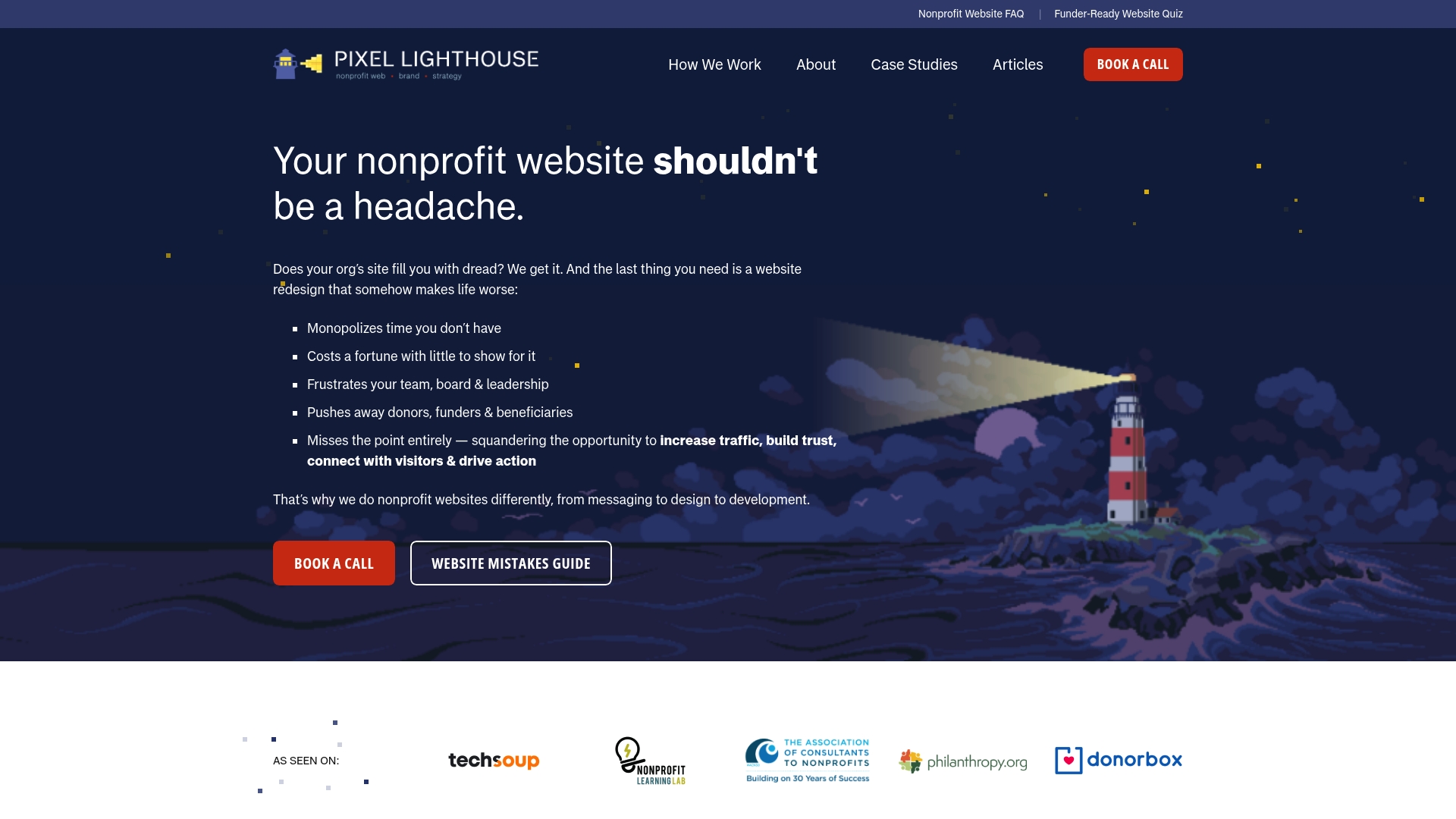
Pixel Lighthouse reports a 63% increase in traffic and a fivefold rise in inquiries for a regional nonprofit after a founder-led redesign. That vendor-reported result frames how they pair messaging work with technical cleanup to drive measurable engagement.
Their team emphasizes workshops, storytelling, and a hands-on build, so your staff will be part of the process from kickoff through launch.
Core Features
- Human-centered website design that prioritizes audience needs and donation or inquiry triggers.
- Collaborative workshops that surface priorities, audience segments, and messaging before any templates are chosen.
- Messaging and storytelling services tailored to nonprofit audiences, plus content migration and simplified information architecture.
- Technical overhaul to improve site speed and manageability, paired with a user-friendly CMS handoff for staff.
Key Differentiator
Pixel Lighthouse runs a founder-led process where the same small team handles strategy, copy, design, and development. That continuity reduces handoffs and preserves narrative intent when content is translated into templates and templates into code. For nonprofits that value authenticity, this model keeps tone, mission, and calls to action aligned.
Pros
- Personalized, boutique delivery. Founders remain involved, so decisions are quick and the output reflects organizational voice rather than an account manager’s summary.
- Sector expertise. The team focuses on nonprofits and understands common fundraising and volunteer conversion flows, which shortens discovery timelines.
- Story-first approach. Workshops and messaging work avoid vague jargon and push toward clearer donation pages and impact stories.
- Measured outcomes. The vendor advertises traffic and inquiry lifts in case studies, providing concrete examples you can test for your own goals.
- Long-term partnership orientation. Support beyond launch is part of the offering, which helps small teams manage updates without hiring full-time staff.
Cons
- Pricing is not published and appears to be bespoke. Expect project-based fees rather than fixed, low-cost packages.
- Outcomes depend on organizational clarity and staff availability. If your team cannot commit to workshops, results will be weaker.
- Smaller agency scale means fewer enterprise-level integrations and custom engineering options compared with large digital firms.
When It May Not Fit
If you need a fixed, low-cost template site without strategic workshops, this approach is the wrong match. If your project requires enterprise single sign-on, complex API work, or a large team of specialists, a larger vendor will be a better technical fit.
Notable Integrations
- Content management systems (CMS)
- Website analytics tools
Pixel Lighthouse works with standard CMS platforms and common analytics stacks to hand over a manageable site and reporting setup.
Who It’s For
Nonprofits that want a strategic, collaborative redesign guided by founders and that can commit staff time to workshops. Ideal for organizations prioritizing storytelling, donor journeys, and a more maintainable site over bargain pricing.
Real World Use Case
A regional nonprofit engaged Pixel Lighthouse for a full redesign and content refresh. According to the vendor, that engagement produced the traffic and inquiry figures above while delivering a faster, easier-to-manage site and clearer donation pathways.
Pricing
Pixel Lighthouse does not publish rates. Pricing is project-based and tailored to scope, audience work, and technical needs. Expect a premium range compared with template services, with costs aligned to the depth of strategy and development you require.
Website: https://pixellighthouse.com
Comparative Analysis
Evaluating these three providers for nonprofit website development reveals distinct areas where each excels, accommodating varying organizational needs and priorities.
Pricing and Transparency
Nonprofit-webdesign offers fixed package pricing starting at $999, providing clarity and budget predictability. In contrast, Doing Good Digital and Pixel Lighthouse utilize project-based fees tailored to scope, which can result in more flexible yet less immediately defined costs. Organizations with rigid budget constraints may value Nonprofit-webdesign’s upfront cost model, while those seeking bespoke solutions might find the tailored proposals from Doing Good Digital and Pixel Lighthouse advantageous despite the added complexity.
Expertise in Strategy versus Implementation
Doing Good Digital specializes in integrating sophisticated digital fundraising platforms and providing staff training, emphasizing long-term digital strategy. Meanwhile, Pixel Lighthouse focuses on storytelling and audience collaboration, ensuring the narrative remains central throughout the design transformation. Nonprofit-webdesign combines streamlined design and staff training, well-suited for smaller teams needing, out-of-the-box solutions. For organizations aiming for strategy-led transformation, Doing Good Digital’s emphasis on consulting and automation could be, whereas nonprofits prioritizing hands-on narrative development might lean toward Pixel Lighthouse.
Measuring Long-Term Suitability
Choosing the right vendor depends on desired post-launch engagement. Nonprofit-webdesign provides training for continued content management and maintenance included as standard, reducing dependency on external developers. In contrast, Pixel Lighthouse emphasizes ongoing partnership but relies more heavily on initial workshops for impact. Organizations desiring a strong basis for independent growth might prefer Nonprofit-webdesign’s structure, while those seeking collaborative development may align better with Pixel Lighthouse’s methodology.
Best Fit Scenarios
- Nonprofit-webdesign: For small or medium nonprofits requiring site design bundled with training and turnkey services within a defined cost structure.
- Doing Good Digital: For organizations seeking deep integrations of multi-channel fundraising platforms coupled with expert guidance in automated donor journeys.
- Pixel Lighthouse: For teams prioritizing storytelling and donor experience improvements through a highly collaborative and narrative-focused approach.
Our Pick: Nonprofit-webdesign
Nonprofit-webdesign combines domain expertise with practical offerings, making it highly effective for small and mid-sized nonprofits seeking impactful websites without overextending resources. However, those requiring highly customized integrations or prioritizing narrative workshops may find superior alignment with Doing Good Digital or Pixel Lighthouse. The choice ultimately depends on organizational priorities and project focus areas.
Nonprofit Website Design Solutions Comparison
For nonprofit organizations seeking donor-friendly and feature-complete website design solutions, this table provides a detailed comparison of leading options based on their key offerings and fit for specific needs.
| Product | Core Feature | Key Differentiator | Best For | Pricing | Notable Limitation |
|---|---|---|---|---|---|
| Nonprofit-webdesign | Comprehensive packages including design, SEO, and hosting services | Expertise in donor-focused website development | Small to mid-sized charities | Starts at $999 | Contact required for custom quotes |
| Doing Good Digital | Implementation and optimization of nonprofit fundraising platforms | Extensive focus on donor journey automation | Nonprofits ready for multi-channel builds | Not disclosed | No public pricing available |
| Pixel Lighthouse | Storytelling-focused redesigns with workshops and collaborative development | Founder-led processes ensuring consistency | Nonprofits prioritizing impactful messaging | Not disclosed | Organizational input heavily influences outcomes |
Choose Nonprofit-webdesign for Donor-Friendly Websites That Empower Your Team
Finding the right fit among webbedpresence.com alternatives can feel overwhelming when your nonprofit needs a donor-focused website that fits a modest budget and reduces ongoing support hassles. Many nonprofits struggle with scattered vendors or sites that ignore donor journeys and require heavy developer reliance for updates.
Nonprofit-webdesign offers a solution built just for small to mid-sized organizations eager to launch professional, accessible websites. Since 2005, we have specialized in affordable, purpose-driven webdesign that empowers your staff with training and includes hosting to keep your volunteers focused on your mission.
Discover how Nonprofit-webdesign bundles design, SEO, and ongoing support so you can streamline donor conversions while retaining control over edits. Don’t wait to get a tailored website plus the know-how to maintain it without extra developer fees—visit us now and book a personal consultation with a nonprofit web expert.
Frequently Asked Questions
What makes Nonprofit-webdesign suitable for small nonprofits?
Nonprofit-webdesign is designed specifically for small to mid-sized nonprofits looking for donor-friendly websites. Their packages begin at approximately $999 and include design, SEO content writing, and post-launch training, allowing staff to manage content effectively. Nonprofits can rightfully expect a tailored solution that fits their budget and capability.
How does Nonprofit-webdesign compare to Doing Good Digital for fundraising platforms?
Doing Good Digital excels in its tailored implementations for integrating complex fundraising platforms like Blackbaud Luminate Online. Organizations seeking in-depth training and strategic consultations would find Doing Good Digital appealing. If you need a more straightforward and budget-friendly option, Nonprofit-webdesign offers a comprehensive package that includes all core website services and builds specifically for nonprofits.
Which services does Nonprofit-webdesign provide for post-launch support?
Nonprofit-webdesign includes post-launch support and training as standard features, allowing staff to manage website updates without developer assistance. This approach ensures that small organizations can maintain their sites effectively while focusing on their missions. Teams can expect to be equipped with the necessary skills to implement updates independently.
Can I expect any hidden costs with Nonprofit-webdesign?
Nonprofit-webdesign packages are transparent, with pricing starting around $999 for basic sites, avoiding the risk of unexpected fees. Since the vendor suggests contacting them for custom quotes on advanced features, nonprofits can budget more accurately right from the start. It’s crucial to ask about any additional costs during the quote phase.
What types of nonprofits benefit the most from Nonprofit-webdesign?
Small to mid-sized nonprofits, community groups, and local charities are particularly well-suited for Nonprofit-webdesign, meeting their need for budget-friendly and donor-focused websites. This allows organizations to save resources and effectively reach their fundraising goals without overwhelming complexity in implementation.