

Your organization’s website is not a digital brochure. For most donors, volunteers, and grant funders, it is the first and most lasting impression your nonprofit makes. Understanding why nonprofits need a professional website goes beyond aesthetics or simply having an online presence. A well-built site, what digital strategists call a mission-driven web platform, directly shapes how much money you raise, how many people engage with your cause, and whether the public trusts you enough to take action. The stakes are real, and the decisions you make about your web infrastructure reflect directly on your mission.
Table of Contents
- Key Takeaways
- Why nonprofits need a professional website for fundraising
- Visibility, SEO, and how structure drives outreach
- Your website as an operational asset
- Building trust through transparency and design
- My take: stop treating your website like a finished project
- Ready to build a site that works as hard as you do?
- FAQ
Key Takeaways
| Point | Details |
|---|---|
| Websites drive fundraising | Optimized donation funnels and trust signals directly increase the number of visitors who become donors. |
| SEO and content structure matter | Dedicated program pages with original content improve search rankings and Google Ad Grant eligibility. |
| Automation reduces staff burden | Integrating sign-ups, renewals, and registrations frees staff time for mission-critical work. |
| Transparency builds donor confidence | Displaying your 501©(3) status, financials, and leadership details reduces donor skepticism. |
| Ongoing maintenance prevents decline | Regular audits prevent technical debt that quietly erodes performance, compliance, and credibility. |
Why nonprofits need a professional website for fundraising
The connection between professional web design and donation revenue is more direct than many nonprofit leaders expect. Only about 1% of nonprofit website visitors convert to donors or subscribers on a typical site. A well-designed donation page, however, can reach conversion rates of 10 to 20 percent. That gap represents real funding your organization is either capturing or leaving on the table.
What drives that difference? Three things: trust signals, reduced friction, and clear calls to action.
- Trust signals include your 501©(3) status displayed prominently, audited financial summaries, donor testimonials, and recognizable payment security icons. Donor trust is strongly influenced by visible governance and financial transparency shown online. When a first-time visitor cannot find these details within seconds, they leave.
- Reduced friction means your donation form loads fast, works on a phone, asks for only what is necessary, and confirms the transaction clearly. Every extra click or form field loses donors.
- Clear calls to action are specific and mission-connected. “Help us feed 200 families this month” outperforms a generic “Donate Now” button because it connects the gift to an outcome.
The urgency of getting this right is reinforced by financial reality. Many nonprofits operate with less than six months of operating reserves, making efficient digital fundraising not a luxury but a necessity. Your website is one of the few fundraising tools that works around the clock without adding staff costs.
Supporting donors’ need for transparency while reducing friction on donation pages drives both conversion and long-term engagement. Repeat donors, not one-time givers, are the foundation of sustainable fundraising. Your site needs to be built to earn and keep that trust.
Pro Tip: Run your donation page through a mobile device used by someone unfamiliar with your organization. If they cannot complete a gift in under three minutes without asking a question, your funnel needs work.
Visibility, SEO, and how structure drives outreach
A professional website serves as your organization’s most persistent outreach tool, but only if people can find it. Search engine optimization (SEO) for nonprofits is not about tricks or technical complexity. It comes down to whether your site gives search engines and visitors clear, substantive content to work with.
One of the most common mistakes is treating all programs as a single block of text on a generic “What We Do” page. Every program or service must have a dedicated page with original, descriptive content. Thin pages do not rank. They also fail to give prospective donors or community partners a clear picture of your work. Localized, content-rich program pages improve both search rankings and supporter clarity, enabling better mission connection.
Here is how a typical nonprofit site compares to a professionally structured one:
| Feature | Typical nonprofit site | Professional nonprofit site |
|---|---|---|
| Program pages | One combined “Programs” page | Individual page per program with full descriptions |
| Mobile experience | Inconsistent or broken on phones | Fully responsive, tested across devices |
| Page speed | Slow, often above 4 seconds to load | Optimized, under 2 seconds |
| HTTPS security | Sometimes missing | Always present |
| Internal linking | Minimal or random | Strategic links between related pages |
| Content updates | Rarely updated | Regular updates with news, stories, and impact data |
Page speed, mobile-friendliness, and HTTPS all directly impact your Google Ad Grant eligibility and organic search rankings. If your organization relies on the Google Ad Grant program, which provides up to $10,000 per month in free advertising, a slow or poorly structured site can disqualify your campaigns or reduce their reach significantly.
For deeper guidance on building out your nonprofit SEO strategy, the approach starts with the same foundation: content that is accurate, original, and organized around how real people search for your cause.
Your website as an operational asset
Most nonprofit leaders think about their website as a communications tool. The organizations that get the most out of their digital infrastructure think about it differently. They treat the website as an operational system that can handle work their staff would otherwise do manually.
Successful organizations view the website as a tool to automate membership renewals and volunteer sign-ups. When these processes live on your site, staff spend fewer hours on administrative tasks and more time delivering programs. Consider what this looks like in practice:
- A volunteer coordinator no longer manually processes every onboarding form because new volunteers complete a structured intake process online, triggering automatic confirmation emails and task assignments.
- An event manager does not collect registrations by email because the site handles ticketing, waitlists, and reminder notifications automatically.
- A membership coordinator does not chase renewal payments because the system sends reminders, processes payments securely, and updates records without human input.
Integrating membership functions and volunteer sign-up automations into the website drastically reduces staff workload and improves the experience for your supporters at the same time.
There is also a longer-term concern that does not get enough attention: technical debt. Every year you defer website updates, accessibility fixes, and security patches, you accumulate what developers call legacy debt. A professional nonprofit website with continuous maintenance prevents this accumulation and keeps the site performing as a mission-critical asset rather than a liability. Regular auditing of website technical and content elements is also required for compliance, grant eligibility, and donor confidence.

Pro Tip: Treat your website the same way you treat your annual budget review. Schedule a quarterly audit of page performance, broken links, outdated content, and form functionality. Small problems caught early cost far less than a full rebuild later.
Building trust through transparency and design
Credibility is not given. It is earned through every element a visitor encounters on your site. The importance of nonprofit websites as trust-building tools is easy to underestimate until you consider what a skeptical first-time visitor is actually looking for.
Here are the four credibility signals that move visitors from curious to committed:
- Mission clarity in seconds. Your homepage should communicate who you serve, how, and why within the first screen a visitor sees. If someone has to scroll or click to understand what your organization does, you have already lost attention.
- Impact data and stories. Numbers without stories feel cold. Stories without numbers feel anecdotal. A professional site combines both: “We served 4,200 meals last month” paired with a photograph and a brief story from someone who received help.
- Governance and financial transparency. Displaying your IRS determination letter, board leadership names, and at minimum a summary of audited financials tells donors you have nothing to hide. Displaying trust signals prominently builds donor confidence and reduces abandonment at the point of giving. Learn how social proof builds donor trust in more detail.
- Accessible, inclusive design. Accessibility compliance should be built in from the start to reduce costs and meet increasing legal mandates. Beyond compliance, an accessible site communicates that your organization genuinely includes everyone, which resonates deeply with many funders and donors.
A site that loads slowly, looks outdated, or buries contact information does not signal disorganization by accident. It signals it precisely. Professional web design removes that doubt before it takes hold.
My take: stop treating your website like a finished project
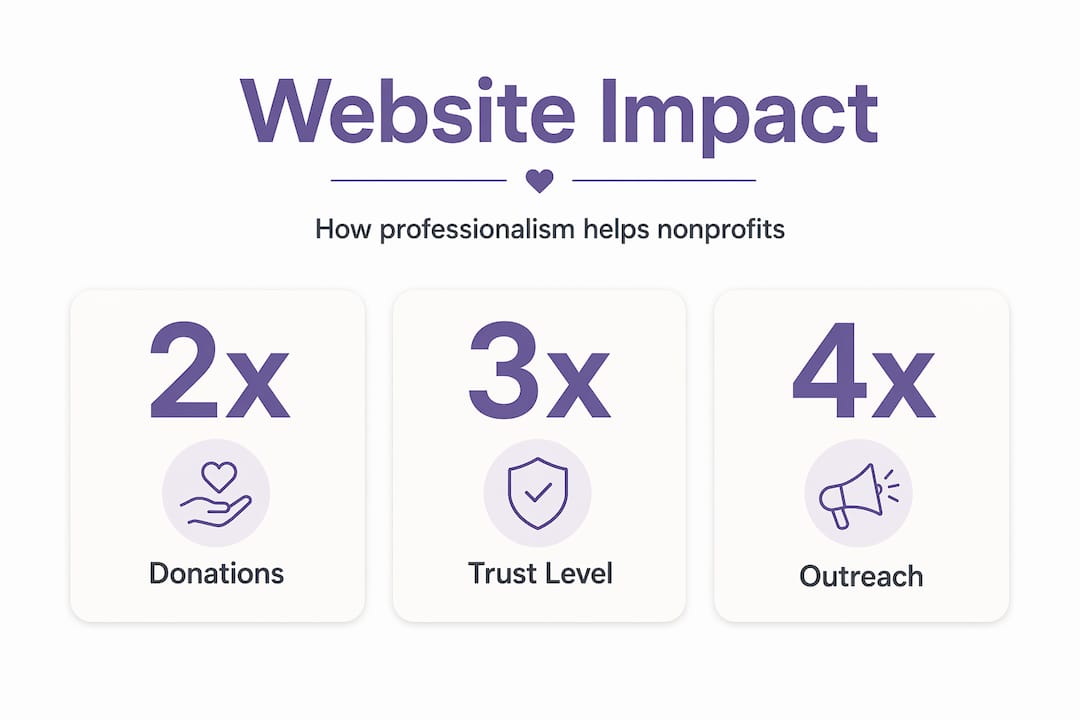
I have worked with nonprofit leaders for long enough to recognize a pattern that holds organizations back more than almost any other single factor. They build a website, feel relief when it is done, and then treat it as something to revisit in five years.
The truth is that the organizations I have seen grow their donor bases, secure larger grants, and expand their community reach all share one habit: they treat their website as an ongoing investment with real operational and strategic value. Not a project with an end date. A living part of the organization.
What surprises many leaders is how much a well-integrated site actually frees up their team. When your site handles intake forms, donation processing, event registrations, and donor acknowledgment emails automatically, your staff focuses on the work that requires human judgment. That is not a minor efficiency gain. For a small organization running lean, it can be the difference between sustainable growth and constant staff burnout.
The other shift I would encourage is about mindset rather than tactics. Nonprofits sometimes resist investing in their websites because they worry about how it looks to donors to spend money on infrastructure. But donors are not confused by a professional, well-functioning website. They are reassured by it. What they do question is an organization that asks for their trust but presents a site that looks abandoned or difficult to use. Your online presence as a nonprofit leader is a direct reflection of how you run the organization.
Prioritize your digital infrastructure now. The cost of inaction compounds quietly until it becomes a crisis.
— Matt
Ready to build a site that works as hard as you do?
If this article has reinforced something you already sensed, that your website could be doing more for your mission, you are in the right place. At Nonprofit-webdesign, we have spent nearly two decades building purpose-driven websites specifically for nonprofits, and we understand the balance between tight budgets and high standards.
Whether your organization needs a full nonprofit website redesign that meets modern accessibility and SEO standards, or you need focused help with your donation funnel optimization to convert more visitors into consistent supporters, our team builds with your mission at the center. We also offer professional design and hosting services to keep your site secure, fast, and up to date year-round. Explore our nonprofit website best practices resources, or reach out to talk through what your organization specifically needs.
FAQ
Why do nonprofits need a professional website?
A professional website builds donor trust, improves search visibility, and creates a reliable channel for fundraising and volunteer engagement. Without one, your organization loses credibility and revenue to organizations that invest in their digital presence.
How does website design affect nonprofit fundraising?
Design directly affects how many visitors complete a donation. Donation page conversion rates can reach 10 to 20 percent with optimized design, compared to the roughly 1 percent average across most nonprofit sites.
What features should a nonprofit website include?
A professional nonprofit site should include dedicated program pages, a streamlined donation form, trust signals like 501©(3) status and financials, mobile-friendly design, and automated forms for volunteer sign-ups and event registrations.
How does SEO help nonprofit organizations?
Strong SEO practices help your organization appear in search results when people look for causes or services you provide. Substantive, well-structured program pages also protect your Google Ad Grant eligibility, which can generate significant additional outreach budget.
How often should a nonprofit update its website?
Nonprofits should update their site content regularly and conduct a technical audit at least quarterly. Ongoing maintenance prevents technical debt from accumulating and keeps the site performing reliably for donors, volunteers, and search engines.