

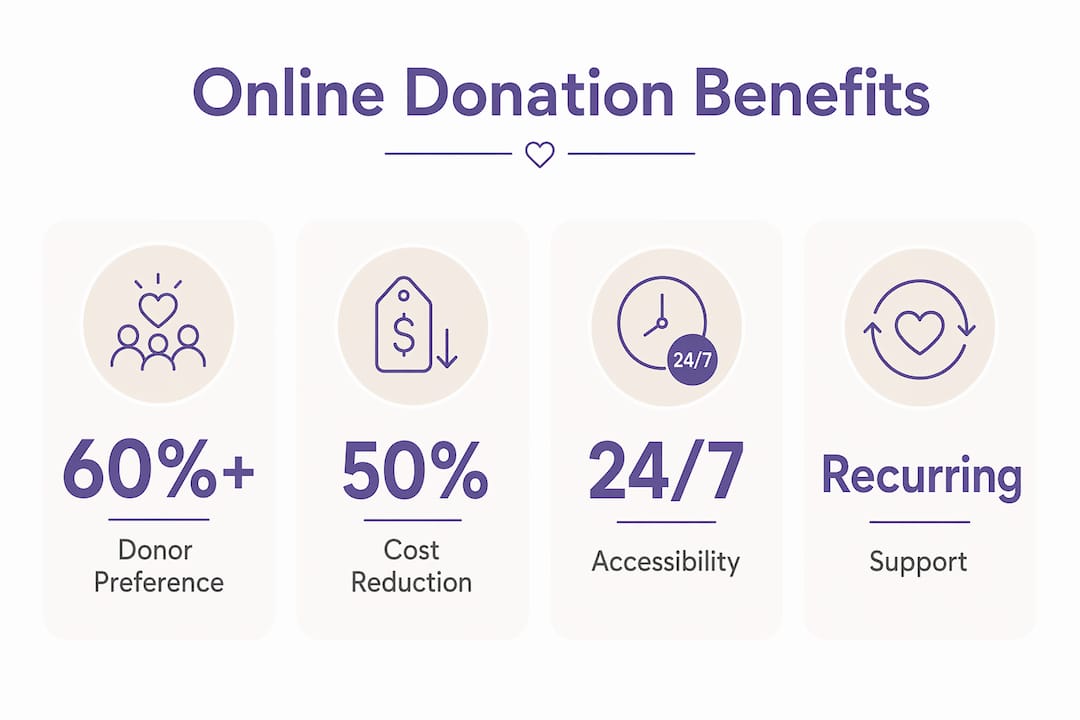
Online donations are defined as charitable gifts made through digital channels, including nonprofit websites, social media platforms, email campaigns, and mobile apps. They have become the foundation of sustainable fundraising for organizations of every size. Over 60% of donors now prefer giving online over traditional methods like checks or in-person events, making digital giving a direct reflection of how supporters want to engage. Online giving grew 11% year over year in 2025, with a peak of 15% growth in November alone. For nonprofit professionals and fundraisers, understanding why online donations matter is no longer optional. It is the difference between an organization that grows and one that stagnates.
Why online donations matter for nonprofits: the core benefits
Digital fundraising, the broader practice of using technology to solicit and process charitable gifts, delivers advantages that go well beyond simply replacing a paper check. The importance of online donations becomes clear when you examine what they make possible operationally, financially, and relationally.
The cost structure alone makes a compelling case. Traditional direct mail campaigns can cost $1.00 to $1.25 per dollar raised for acquisition. Online campaigns, by contrast, carry far lower per-transaction costs, especially when recurring giving programs reduce the need for constant re-acquisition. Platforms like Salesforce Nonprofit Success Pack and Bloomerang integrate directly with donation forms, automating acknowledgment emails, tax receipts, and donor records without additional staff time.

The benefits for nonprofits extend into audience reach as well. A well-optimized donation page on your website is accessible to anyone with an internet connection, 24 hours a day. That reach is impossible to replicate through events or phone campaigns. Social media platforms like Facebook and Instagram offer built-in fundraising tools that let supporters create peer-to-peer campaigns on your behalf, multiplying your reach without multiplying your budget.
Recurring giving is one of the most underappreciated benefits of digital fundraising. Monthly donors give an average of 42% more annually than one-time donors, and online platforms make it easy to set up and manage automatic recurring gifts. This creates predictable revenue that helps nonprofits plan programs and staffing with confidence.
- Lower acquisition costs through automated email and digital ad campaigns compared to direct mail
- Recurring donation programs that generate predictable monthly revenue and higher lifetime donor value
- CRM integration with tools like Salesforce, Bloomerang, or DonorPerfect to automate stewardship and reduce manual data entry
- Expanded donor reach through mobile-optimized pages, social media, and search-driven traffic
- Year-end campaign support, given that 36.1% of annual giving concentrates in Q4, requiring digital infrastructure to handle volume spikes
Pro Tip: Set up a dedicated recurring giving landing page separate from your general donation form. Donors who land on a page specifically framed around monthly impact convert at significantly higher rates than those presented with a one-time default.
What operational factors make online donations sustainable
Accepting a donation online sounds simple. In practice, it involves a chain of interconnected systems, each of which can fail or underperform. Digital giving requires complex operational systems beyond payment processing, including donor onboarding journeys, supporter communication sequences, and search engine visibility.
Here is what that operational chain looks like in practice for a mid-sized nonprofit:
- Donation form design and placement. The form must load quickly, work on mobile devices, and present giving amounts that reflect your donor base. A form buried three clicks deep on a desktop-only page will lose donors before they complete a gift.
- Payment routing and processor reliability. Processors like Stripe, PayPal Giving Fund, and Authorize.net each carry different fee structures and payout timelines. Choosing the wrong processor for your volume can cost thousands annually in unnecessary fees.
- CRM data capture. Unreliable payment systems and weak CRM integration cause donor data loss and hamper retention. Every transaction must write cleanly to your donor database to support future stewardship.
- Tax receipt compliance. Charitable deductions for online cash gifts depend on itemization and adjusted gross income, making accurate receipts critical to donor trust and IRS compliance. Automated receipt systems remove the risk of human error.
- Q4 campaign planning. Year-end giving is heavily concentrated, so nonprofits must plan complex Q4 campaigns with staged messaging, matching gift promotions, and capacity testing to handle traffic spikes without system failures.
The organizations that treat online donation technology as a core part of their fundraising system, rather than a bolt-on feature, consistently outperform those that do not. Marketing traffic alone does not secure sustainable giving. The full donor journey from first click to recurring gift requires deliberate architecture.
Pro Tip: Run a full technical audit of your donation funnel every six months. Test your forms on three different mobile devices, check your CRM sync, and confirm your tax receipts are firing correctly. Small failures compound quietly over time.
What risks come with relying on online donation platforms?
The impact of digital fundraising is real, but so are the risks. Nonprofits that concentrate their online giving infrastructure on a single third-party platform expose themselves to operational and financial vulnerabilities that can be severe.
The most striking recent example is the Flipcause platform collapse, which left 3,200 nonprofits with an estimated $29 million budget gap in 2025. Organizations that had built their entire online giving program on Flipcause lost access to donor data, pending transactions, and campaign history overnight. That is not a hypothetical risk. It happened.
The structural problem runs deeper than any single platform failure. Regulatory oversight of online fundraising platforms is minimal, creating a compliance gap that nonprofits cannot rely on government protection to fill. For-profit intermediaries control the flow of donations, the terms of service, and the fee structures. When those terms change, nonprofits have limited recourse.
Key risks to assess and manage include:
- Platform concentration risk: Routing all online giving through one vendor creates a single point of failure for your revenue stream
- Data ownership gaps: Many platforms retain donor data in proprietary formats, making migration difficult if you need to switch vendors
- Fee structure changes: Platforms can alter processing fees or introduce new charges with minimal notice, directly affecting your net revenue
- Regulatory exposure: Without strong platform oversight, nonprofits bear the compliance burden for data security and donor privacy
- Term-of-service changes: Platforms can restrict certain types of campaigns or causes, potentially blocking fundraising for specific programs
Mitigation starts with due diligence before signing any platform agreement. Review contract terms for data portability, exit clauses, and fee escalation provisions. Diversify your giving options across at least two platforms or payment processors. And maintain your own donor database, independent of any single vendor’s system. A professional nonprofit website with a self-hosted donation form gives you a baseline of control that third-party platforms cannot take away.
How to leverage online donations for maximum impact
Strategic digital fundraising goes beyond having a donate button on your homepage. The nonprofits seeing the strongest results in 2026 are building giving programs that align with donor behavior, cultivate mid-level supporters, and use data to refine their approach continuously.
The following comparison shows the difference between a reactive and a strategic approach to online giving:
| Approach | Reactive | Strategic |
|---|---|---|
| Donation page | Generic form, desktop-focused | Branded, mobile-optimized, with giving tiers |
| Donor segmentation | All donors receive the same messaging | Mid-level and major donors receive tailored outreach |
| Platform diversification | Single platform dependency | Two or more processors plus owned website form |
| Data use | Transactions recorded manually | CRM integration with automated stewardship sequences |
| Year-end planning | Campaign launched in December | Staged Q4 campaign beginning in October with matching gifts |
Large organizations grew 11.7% year over year in 2025 while small organizations declined 6.4%. The gap is not explained by mission quality. It is explained by infrastructure, donor segmentation, and the capacity to cultivate mid-level and major gifts alongside online giving. Mid-level donors, typically those giving between $1,000 and $10,000 annually, represent a critical growth opportunity that online giving programs can support through personalized digital outreach.
AI-assisted tools like Salesforce Einstein, Bloomerang’s predictive analytics, and DonorSearch are now accessible to mid-sized nonprofits and can identify which donors are most likely to upgrade their giving. Pairing those insights with a well-designed donation funnel creates a system that grows revenue without proportionally growing staff costs.
Pro Tip: Build a separate giving page for mid-level donors that acknowledges their existing relationship with your organization and presents a specific program impact tied to a $500 or $1,000 gift. Personalization at this level consistently outperforms generic campaign pages.
Mobile optimization is non-negotiable. More than half of nonprofit website traffic now arrives on mobile devices, and a donation form that does not render correctly on a smartphone is a direct revenue loss. Mobile-friendly donation pages reduce friction at the most critical moment in the donor journey.
Key takeaways
Online donations matter for nonprofits because they align with donor preferences, reduce fundraising costs, and create the recurring revenue infrastructure that sustains programs and growth over time.
| Point | Details |
|---|---|
| Donor preference drives necessity | Over 60% of donors prefer online giving, making digital channels the primary fundraising channel. |
| Operational systems determine outcomes | Reliable CRM integration, payment routing, and tax receipts convert one-time gifts into lasting relationships. |
| Platform risk is real and recent | The Flipcause collapse left 3,200 nonprofits with a $29M gap, proving vendor diversification is critical. |
| Size gap requires strategic response | Large nonprofits grew 11.7% while small ones declined 6.4%, highlighting the value of mid-level donor cultivation. |
| Q4 concentration demands preparation | 36.1% of annual giving happens in Q4, requiring staged campaigns and tested infrastructure well before December. |
What I’ve learned watching nonprofits win and lose online
I have spent years watching nonprofits approach online giving in two very different ways. Some treat it as a technical checkbox: add a donate button, pick a platform, and move on. Others treat it as a fundraising system that requires the same strategic attention as a major gifts program. The outcomes are not comparable.
The organizations that grow are the ones that ask hard questions about their donor data. Who owns it? Where does it live? What happens if the platform changes its terms? These are not paranoid questions. They are the questions that the 3,200 nonprofits affected by the Flipcause collapse wish they had asked earlier.
I also think the sector underestimates how much donor relationships depend on digital experience quality. A slow, confusing donation page does not just lose a transaction. It communicates something about your organization’s competence and care. Donors notice. The digital outreach strategies that work best are the ones that treat every touchpoint as a relationship moment, not just a transaction opportunity.
The growth data from Blackbaud is encouraging, but the bifurcation between large and small organizations should concern every fundraiser at a smaller nonprofit. The gap is closeable. It requires investment in infrastructure, not just in campaigns. And it requires treating your website and donation systems as core organizational assets, not afterthoughts.
The nonprofits that will thrive in 2026 and beyond are the ones building owned digital infrastructure now, diversifying their platform relationships, and cultivating mid-level donors with the same intentionality they bring to major gifts. That is not a prediction. It is what the data already shows.
— Matt
How Nonprofit-webdesign helps you build a stronger giving program
Your online giving results depend heavily on the quality of your digital infrastructure. Nonprofit-webdesign has worked with mission-driven organizations since 2005, building websites that convert visitors into donors and support long-term fundraising growth.
A professionally designed, mobile-optimized nonprofit website reduces friction at every stage of the donor journey, from first impression to completed gift. Nonprofit-webdesign also offers donation funnel optimization services that analyze your current giving flow, identify drop-off points, and implement tested improvements that increase both conversion rates and average gift size. Whether you are launching a new site or updating an existing one, the goal is the same: a digital presence that reflects your mission and makes it easy for supporters to give.
FAQ
Why do online donations matter for small nonprofits?
Online donations give small nonprofits access to a global donor base at a fraction of the cost of traditional fundraising methods. They also enable recurring giving programs that create predictable monthly revenue, which is especially valuable for organizations with limited staff.
What percentage of nonprofit giving happens online?
36.1% of annual nonprofit giving concentrates in Q4, with online channels driving the majority of that volume. Online giving grew 11% year over year in 2025, confirming its central role in modern fundraising.
How can nonprofits reduce the risk of platform dependency?
Nonprofits reduce platform risk by diversifying across at least two payment processors, maintaining an independent CRM, and hosting a self-owned donation form on their website. Reviewing platform contracts for data portability and exit terms before signing is equally critical.
What makes a nonprofit donation page effective?
An effective donation page loads quickly on mobile devices, presents clear giving tiers tied to specific program impacts, and integrates directly with your CRM for automatic acknowledgment and tax receipts. Reducing the number of form fields and removing navigation distractions also increases completion rates.
How do online donations support year-end fundraising?
Because year-end giving is heavily concentrated in Q4, nonprofits use online channels to run staged campaigns with matching gift promotions, countdown messaging, and segmented donor outreach starting in October. Digital infrastructure allows organizations to handle high transaction volumes without the delays that affect mail-based campaigns.