

A single label changed everything. Marking one donation amount as “Most Popular” increased revenue by 94% on a nonprofit donation page. That is not a design overhaul or a major campaign. It is social proof at work, and most nonprofit leaders in California are barely scratching the surface of what it can do. The role of social proof on nonprofit websites goes far beyond a few donor quotes tucked into a footer. When applied with intention, it reshapes how visitors feel about giving, reduces hesitation, and turns first-time visitors into committed supporters. This guide shows you exactly how.
Table of Contents
- What is social proof and why does it matter for nonprofit websites?
- How social proof builds trust and credibility on nonprofit websites
- Types of social proof to use on nonprofit websites and how to apply them
- Expert tips and nuanced strategies for maximizing social proof impact on nonprofit sites
- Why social proof is the nonprofit’s secret weapon for sustainable generosity
- Strengthen your nonprofit’s impact with expert website design and social proof integration
- Frequently asked questions
Key Takeaways
| Point | Details |
|---|---|
| Social proof defined | Social proof is evidence that others support your nonprofit, making giving feel normal and trustworthy. |
| Trust builder | Clear fund usage, partner logos, and transparent impact data increase donor confidence and giving. |
| Effective formats | Testimonials, endorsements, media coverage, and stats work together best when authentic and strategically placed. |
| Placement matters | Position social proof near donation buttons and on landing pages to boost conversions dramatically. |
| Expert tactics | Use named individuals with photos, combine stories with data, and leverage community influencer testimonials. |
What is social proof and why does it matter for nonprofit websites?
Social proof is the principle that people look to the behavior and opinions of others to guide their own decisions. In the context of nonprofit websites, it means showing visitors that real people, respected organizations, and credible media outlets already support your cause. When someone lands on your site unsure whether to give, social proof answers the unspoken question: “Can I trust this organization?”
The psychology behind it is well established. People are more likely to donate when they see others giving, because it signals that the cause is legitimate and the behavior is normal. Giving no longer feels like a risk. It feels like joining something that already has momentum.
For nonprofit leaders and web designers in California, this matters because the online giving space is crowded. Donors have more choices than ever, and attention spans are short. Social proof is one of the fastest ways to communicate trustworthiness without asking visitors to read through pages of content.
Here are the most common and effective forms of social proof for nonprofit websites:
- Donor testimonials: Personal stories from people whose lives were changed by your work
- Real-time giving counters: Live tallies showing how many people have donated or how much has been raised
- Partner logos: Visual endorsements from reputable organizations you work with
- Media mentions: Coverage from recognized news outlets or publications
- Impact statistics: Concrete numbers showing what donations have accomplished
- Social media activity: Follower counts, shares, and community engagement visible on your site
Each of these tells a different part of the same story: your nonprofit is trusted, active, and effective. You can explore best practices for nonprofit websites to see how these elements fit into a broader site strategy.
How social proof builds trust and credibility on nonprofit websites
Trust is not built in a single moment. It accumulates through repeated signals that tell visitors your organization is transparent, accountable, and effective. Social proof is one of the most efficient ways to send those signals quickly.

Consider this: visitors decide within 15 seconds whether to stay on a nonprofit website. That is not enough time to read your mission statement or scroll through your annual report. It is, however, enough time to notice a row of recognizable partner logos, a counter showing 12,000 donors, or a quote from a community member whose life improved because of your work.
Transparency plays a major role here. About 50% of donors give more when nonprofits clearly show how funds are used and display partner logos. Donors want to know their money is going somewhere real. Showing fund allocation alongside partner endorsements removes the uncertainty that stops people from clicking “Donate.”
“The fastest way to earn donor trust is to show them that others already trust you. Social proof does that before a visitor reads a single word of your mission statement.”
Effective nonprofit website credibility comes from layering these signals. A first-time visitor might be reassured by your media mentions. A returning visitor might be moved by a new impact report. A donor considering a major gift might look for partner endorsements and board transparency. Your nonprofit website design should account for all of these visitor types and serve each one the right signal at the right moment.
Strong trust factors for nonprofit websites include:
- Named testimonials with photos and specific outcomes
- Clearly displayed charity ratings or watchdog badges (such as Charity Navigator or GuideStar)
- Impact reports with real numbers, not vague language
- Partner logos from organizations your audience already recognizes
- Media mentions with publication names and dates visible
Pairing these with solid SEO strategies for nonprofits means the visitors who find you through search already arrive with some context, making your social proof even more effective at converting them.
Types of social proof to use on nonprofit websites and how to apply them
Not all social proof carries equal weight. The type you use, and where you place it, determines how much it actually moves donors. Here is a practical breakdown.
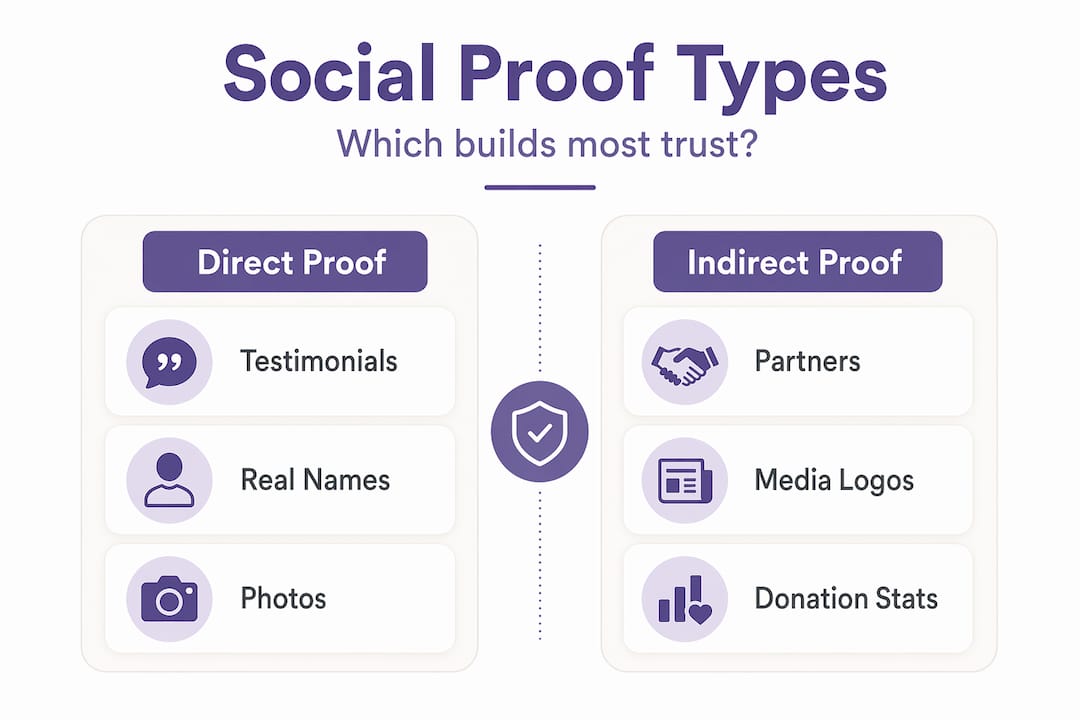
| Type of social proof | Best placement | Primary benefit |
|---|---|---|
| Donor testimonials | Homepage, donation page | Emotional connection |
| Partner logos | Header, about page, footer | Instant credibility |
| Media mentions | Homepage, press page | External validation |
| Impact statistics | Homepage, campaign pages | Evidence of effectiveness |
| Real-time giving counters | Donation page | Urgency and momentum |
| Social media follower counts | Footer, sidebar | Community size signal |
Testimonials from changed lives create emotional connections that motivate donors in ways that statistics alone cannot. But the key word is “authentic.” A vague quote like “This organization does great work” from “A satisfied donor” does nothing. A named quote with a photo, a specific outcome, and a real location tells a story that visitors can believe.
Here is how to apply each type effectively:
- Collect testimonials with structure. Ask donors and beneficiaries specific questions: What changed in your life? What would you tell someone considering a donation? Specific answers produce specific quotes.
- Display partner logos prominently. Place them above the fold on your homepage or near your donation call to action (CTA). Logos from known organizations transfer credibility instantly.
- Secure and display media coverage. Even a mention in a local California publication adds external validation. Link to the article and display the publication’s logo.
- Use impact data with context. “We served 3,200 meals last month” is stronger than “We feed the hungry.” Numbers without context feel abstract. Numbers with a story feel real.
- Add real-time counters to donation pages. Showing that 847 people have already given to a campaign creates momentum. It makes giving feel like joining a movement rather than making an isolated decision.
Pro Tip: Place your strongest social proof element within the first screen a visitor sees. Do not make them scroll to find evidence that your nonprofit is credible. That credibility needs to be immediate.
Simple labels like “Most Popular” on donation tiers are a form of social proof too, and the data shows they work. If you are not testing your donation page labels, you are leaving revenue on the table. Your donation funnel optimization strategy should include A/B testing these elements regularly.
For nonprofits evaluating how to manage donor data alongside social proof collection, reviewing your options for donor management software is a practical next step. Organizations like Publicity for Good also offer endorsement and PR support that can generate the kind of media coverage that becomes powerful social proof.
Expert tips and nuanced strategies for maximizing social proof impact on nonprofit sites
Most nonprofits get the basics right. They add a testimonials section and call it done. The organizations that see real results go further, and the difference often comes down to a few specific choices.
Use named individuals with photos. Anonymous testimonials invite skepticism. When visitors see a real name, a real face, and a real location, they believe the story. “Maria G., Sacramento, CA” is more convincing than “A grateful donor.” This is especially important for California nonprofits where local identity and community connection carry weight.
Start with story, then add data. Story-driven fundraising outperforms stats-first approaches by up to 22 times in retention and engagement. Lead with a human experience, then back it up with numbers. The emotional connection opens the door; the data closes it.
Leverage local and community influencers early. Early-stage nonprofits benefit significantly from testimonials by community influencers. If you are a newer organization without a long donor history, a quote from a respected local figure, a faith leader, a school principal, or a neighborhood business owner carries real weight. You do not need a celebrity endorsement to build credibility.
“The most overlooked source of social proof for new nonprofits is the community they already serve. The people closest to your mission are your most credible voices.”
Here are additional strategies that experienced nonprofit web designers apply:
- Rotate testimonials by campaign. Match the testimonial to the specific ask. A food drive page should feature a story about hunger, not housing.
- Show momentum, not just history. “Join 2,400 donors this year” is more compelling than “We have served our community for 20 years.” Both matter, but momentum signals urgency.
- Place social proof directly above or beside donation CTAs. The moment of decision is when trust matters most. Do not make donors scroll back up to remember why they wanted to give.
- Update your social proof regularly. Outdated testimonials or stale statistics signal neglect. Fresh, dated content tells visitors your organization is active and accountable.
Pro Tip: Test two versions of your donation page, one with social proof placed above the CTA and one without. Even a modest lift in conversion rate compounds significantly over a full fundraising year.
For more practical guidance on applying these ideas across your full site, the nonprofit webdesign blog covers design and strategy topics specific to mission-driven organizations.
Why social proof is the nonprofit’s secret weapon for sustainable generosity
Here is something most marketing guides will not tell you: social proof is not a tactic. It is a relationship tool. When you display a donor’s story, you are not just persuading the next visitor to give. You are honoring the person who gave, reinforcing their identity as a supporter, and showing every future donor what it looks like to be part of your community.
The nonprofits that treat social proof as a checkbox, a testimonials section they update once a year, miss this entirely. They get a small lift in conversion and wonder why donors do not return. The organizations that treat it as an ongoing conversation with their community build something different: a culture of giving where each donor sees themselves reflected in the people who gave before them.
Social proof turns abstract mission promises into relatable human experiences that donors can believe in and support repeatedly. That is the difference between a one-time gift and a lifelong relationship. In California’s competitive nonprofit landscape, where donors are sophisticated and options are plentiful, that distinction is everything.
We have worked with nonprofits since 2005, and the pattern is consistent. Organizations that invest in authentic, well-placed social proof do not just raise more money in a single campaign. They retain donors at higher rates, attract larger gifts over time, and build the kind of community trust that sustains a mission through difficult years. The ones that skip it rely on constant acquisition, which is expensive and exhausting.
Social proof also respects your donors. It does not manipulate them with pressure tactics. It shows them evidence, real people, real outcomes, real partners, and trusts them to make an informed decision. That transparency is what separates trustworthy nonprofits from the ones donors quietly stop supporting. Your nonprofit website design should reflect that commitment to honesty at every level.
Strengthen your nonprofit’s impact with expert website design and social proof integration
You now understand how social proof works and where it belongs on your site. The next step is making sure your website is actually built to carry it effectively.
Since 2005, we have helped nonprofits across California build professional, purpose-driven websites that put trust at the center of every page. Our nonprofit website design services are built around the psychology of donor behavior, which means social proof is not an afterthought. It is woven into the structure from the start. Whether you need a full nonprofit website redesign that integrates testimonials, partner logos, and impact data, or targeted donation funnel optimization that tests and improves your giving page, we bring the experience and focus your mission deserves. Let your website do the trust-building work so you can focus on the work that matters.
Frequently asked questions
What is social proof in the context of nonprofit websites?
Social proof refers to signals on nonprofit websites, such as donor testimonials, partner logos, and real-time donation counts, that demonstrate others support the cause and encourage visitors to give. As DonorDock explains, it is evidence that other people have found value in giving to your nonprofit.
How does social proof impact donor trust and giving behavior?
Social proof reduces hesitation by showing that giving is normal and credible, which increases donor confidence and the likelihood of donation. People are much more likely to donate when they see others giving, making it a powerful motivator for first-time and returning donors alike.
What types of social proof should nonprofit websites include?
Effective social proof includes authentic donor testimonials, trusted partner endorsements, media coverage, and clear impact data prominently displayed throughout the website. Displaying partner logos, media mentions, testimonials, and impact statistics are the key forms that build credibility quickly.
Where should social proof be placed on a nonprofit website for best effect?
Place social proof near key calls to action like donation buttons and on landing pages to quickly establish trust and encourage giving. Placing social proof close to donate buttons has been shown to significantly boost donation revenue in A/B testing.
Can early-stage nonprofits use social proof effectively?
Yes, early-stage nonprofits can accelerate trust by featuring testimonials from community influencers and partners before building an extensive donor history. Community influencer testimonials carry significant weight for new nonprofits working to establish credibility quickly.